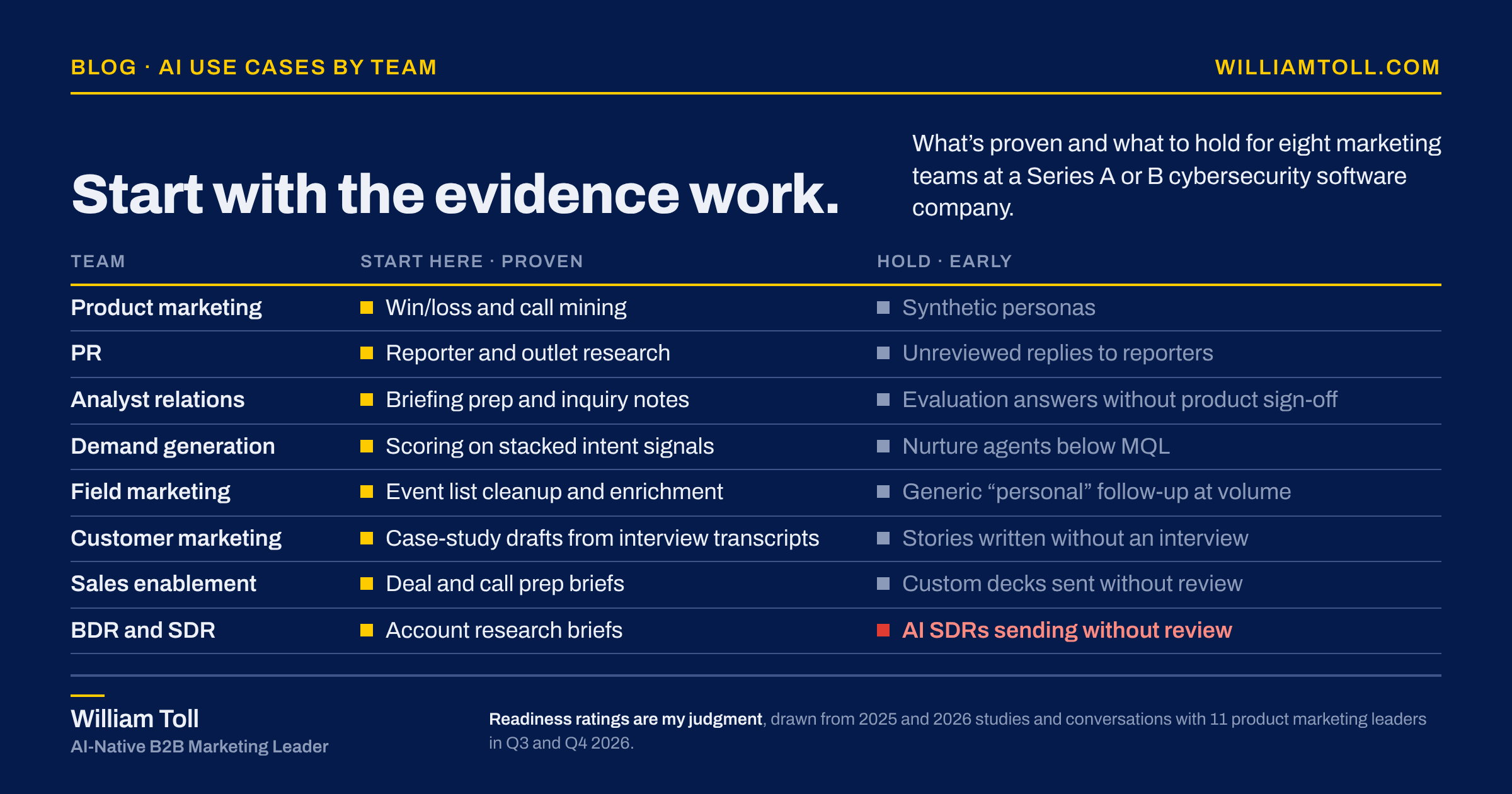
Bottom line
At a Series A or B cybersecurity software company selling to enterprises, AI pays first where it does the research and people make the calls. Win/loss mining, account research briefs and event data cleanup are proven. Uses that act on the buyer directly, such as AI SDRs sending unreviewed email, are still early. Give each team one workflow, one human gate and one business number, and start with the evidence work.
Security buyers read vendor claims the way they read logs, line by line, looking for the entry that doesn’t add up. That’s why AI in cybersecurity marketing has to start with evidence.

Why a Series A or B cybersecurity software company is a special case
Picture an enterprise cybersecurity software company a year or two past its Series A or B. Marketing fits around one table, the pipeline target doesn’t, and every buyer has an engineer who will test each claim against the product.
That buyer does a lot of homework before talking with anyone. In a Ponemon Institute and NOLA Marketing study of 320 enterprise cybersecurity decision-makers, more than a third used AI somewhere in product selection. Peer recommendations ranked highest in vendor discovery, at 55%, and research and survey reports had the strongest direct impact of any asset type, at 46%. Gartner found 67% of B2B buyers prefer a rep-free experience. In a Gartner survey of 645 buyers fielded over the same period, 69% prefer to validate AI-generated insights with a sales rep.
Read together, buyers want to skip the rep until they need a fact checked. That moment decides a lot of security deals. AI only helps if the rep’s answer matches what the buyer already read in an LLM answer.
So a Series A or B team works under four constraints at once: few people, a skeptical technical buyer, long cycles and analyst evaluations that shape enterprise shortlists. Those constraints decide which AI work pays.
How I rate readiness
I use three ratings. Proven means the use case runs in production at a meaningful number of companies, with published results or practitioner accounts behind it. Scaling means it’s past pilots at a growing share of companies. Early means mostly pilots, or vendor claims without independent results.
The map
| Team | Start here (proven) | Next (scaling) | Hold (early) | Gate a person owns | Report |
|---|---|---|---|---|---|
| Product marketing | Win/loss and call mining for message evidence; answer-first content for SEO, AEO and GEO drafted from approved claims | Competitive intel agents that refresh battlecards | Synthetic personas in place of buyer research | PMM approves positioning and every claim; an SE or product manager signs off on any product truth not already in the claims ledger or a support documentation MCP | Win rate; message adoption in calls; citations on tracked prompts |
| PR | Reporter and outlet research; first drafts from an approved fact base | Executive commentary on your research placed in high-authority outlets, tracked for LLM citations | Unreviewed replies to reporters | Whoever owns press signs every external word | Pickups that name your research; citations on tracked prompts |
| Analyst relations | Briefing prep and inquiry notes | Evaluation and questionnaire drafts from approved claims | Evaluation answers sent without product sign-off | AR lead and product sign each answer | Analyst references; evaluation inclusion |
| Demand generation | Account and lead scoring on stacked intent signals; ad and email variant tests | An AI search sprint on the top 50 buyer questions | Nurture agents for leads below MQL | Marketing ops approves scoring changes | Pipeline; cost per qualified lead |
| Field marketing | List ingestion, cleanup and enrichment | Attendee scoring and routing on signals; event-to-opportunity reporting | Generic “personal” follow-up at volume | Reps send the follow-up | Opportunities created in 90 days; days to close |
| Customer marketing | Case-study drafts from interview transcripts | Several versions of each story (case study, page, YouTube video and Short, PDF) aimed at buyer prompts you don’t rank for yet | Customer stories written without an interview | Customers approve every quote attributed to them | References delivered; influenced pipeline |
| Sales enablement | Deal and call prep briefs | Live battlecards, role-play and post-call scoring | Custom decks sent to buyers without review | Enablement owns what’s approved | Seller use; win rate where content is used |
| BDR and SDR | Account research briefs before every call | Signal-ranked call lists and send timing; short, role-specific first emails; live objection prompts; post-call scoring | AI SDRs sending without review | PMM approves sequence structure; the BDR picks the play | Positive replies; meetings held; accepted opportunities |
Team by team
Product marketing
Product marketing shapes what every other team says and has the least room for error, so put AI on the evidence and keep people on the positioning. Win/loss interviews, call recordings and support tickets hold the proof a security buyer will accept, and AI can now turn that raw material into usable plans quickly. Prashant Sridharan, whom PMM Hive identifies as head of product marketing at Supabase, described turning customer calls, specs, roadmap and research into a launch plan written into Notion (your team might use Monday, Asana, Jira or another platform). Tactics become Linear issues. He put the time at “about twenty minutes, including the time I spend guiding the reasoning” (PMM Hive).
Content is where most teams start. In The CMO Survey, 73.9% of companies use AI for content creation, and 41.5% now use it for generative engine optimization. For a cybersecurity software company the bar is higher than speed. Every post, page and brief should be written answer-first for SEO, AEO and GEO, drafted only from approved claims, and checked against product truth before anyone outside sees it. Any claim not already cataloged in the claims ledger or a support documentation MCP needs sign-off from an SE or a product manager. If the most marketing-skeptical solutions engineer on your team can read it and stand behind it, it’s ready.
Positioning is where I’d hold the line. Agents can gather the evidence and test the message, but choosing the market and the claim is the job, and it stays with a person until there is confidence in the data sources and the review gates are strong enough to catch errors. Only 6% of B2B marketing leaders trust AI to contribute meaningfully to positioning, in a Move Forward Strategies survey of 277 leaders in the UK and Ireland. In security, I’d put a claims ledger first. Every number, customer name and integration claim carries a source, an owner and an expiry date, and agents draft only from the ledger. In the agent system I helped build and run, a refuter strips any statistic or quote it can’t trace to a published source before a person reviews the draft.
I’d hold synthetic personas. They’re quick, they tend to echo your own assumptions back, and security buyers are too specific for that.
PR
Earned media now feeds the answer engines. Muck Rack’s Generative Pulse team analyzed more than 25 million links. Earned media accounted for 84% of AI citations in its May 2026 edition, and paid and advertorial content for 0.3% (Muck Rack). For a Series A or B company without a brand budget, that changes what a trade-press story is worth. My read is that a good one can keep surfacing long after launch, whenever buyers ask an LLM about your category.
PR teams have noticed. In Muck Rack’s State of PR 2026, a survey of 971 PR professionals fielded in May and June, 73% call generative engine optimization at least somewhat important. Securing coverage in high-authority publications is their most common tactic for AI visibility, chosen by 55%. Half of them, 51%, say thought leadership now makes up at least a quarter of the job. Measurement lags, with 39% not currently measuring GEO and 29% saying no one at their organization owns it.
Results data is thinner and mostly comes from vendors. Stacker, which sells content distribution, reported a 2.4x lift in how often those brands were cited after it distributed 87 of their stories (Stacker). I haven’t found an independent study that isolates what a placed executive quote does for LLM citations, so I’d treat agency case results as promising and unaudited.
AI handles the legwork well: reporter and outlet research, coverage summaries and first drafts of releases built from an approved fact base. Executive commentary pegged to your research, placed in high-authority outlets and tracked for LLM citations, is scaling. Two things stay human. Replies to reporters go out as options with a short risk memo, and whoever owns press relations picks one. At a Series A or B company, that’s often the CMO, working with an outside agency. Executive quotes come from the executive, in their own words, and every claim inside one traces to the ledger.
Analyst relations
In enterprise security, analyst evaluations often shape shortlists, and on a team that fits around one table, AR is usually somebody’s second job. Terezia Stancik, Senior Analyst Relations Manager at Shopware, told PMM Hive that major analyst evaluations once meant weeks of drafting hundreds of questionnaire answers. With an AI tool she built for those RFPs and questionnaires, she said, “what used to take weeks now takes under five working days with just a few stakeholders” (PMM Hive).
Draft evaluation and questionnaire answers only from approved claims, and have product sign every technical answer. Stancik named agentic digital twins, AI agents that know every report and remember every briefing, as the biggest potential disruptor ahead. I’d file that under early and keep the relationship itself human. Report analyst references, evaluation inclusion and the follow-ups you close after each briefing.
I’d rather walk into an analyst briefing with three proof points I can defend than ten I can’t.
Demand generation
AI use for targeting and segmentation keeps climbing. Since fall 2023, AI for targeting rose from 31.7% to 45.2% of companies, and for segmentation from 21.5% to 35.6% (The CMO Survey). Depth lags, though. Among enterprise marketers who personalize, 58% call their personalization basic (CMI).
Scoring on stacked intent signals and variant testing are proven. An AI search sprint on your top 50 buyer questions is scaling, and in my view it’s the cheapest discoverability work a Series A or B team can run. Nurture agents for leads below MQL are early.
Report on three clocks: signals in hours, conversion in weeks and pipeline in months. B2B cycles run 6 to 18 months or longer, per CIMM, so a pipeline number alone will lag every change you make. Agree on definitions with sales before the quarter starts.
Field marketing
Events are expensive for a Series A or B company. They’re also hard to defend. CMI found 88% of enterprise marketers allocated budget to experiential in 2025, yet 25% aren’t sure what they spend and 39% measure revenue or ROI. At the same time, 44% say deals close faster when experiential is involved.
Agents can now handle most of the event data loop. Badge scans and registrant lists sync into the CRM, and agents dedupe records, match people to accounts and enrich them. Scoring and routing attendees on signals is scaling. Reps send the follow-up themselves. Report opportunities created from attending accounts within 90 days, and days to close on deals with an event touch against matched deals without one.
Customer marketing
I’d argue customer proof carries more weight in security than almost anywhere. In the Ponemon and NOLA study, peer recommendations led vendor discovery for enterprise security buyers. Retention also matters more than budgets suggest. In The CMO Survey, customer retention is the strongest performance metric, growing 12.8% against 7.4% for acquisition. Acquisition budgets still run 26.0% larger than retention budgets.
Proven work here turns customer interview and call transcripts into case-study drafts the customer approves. Anthropic says its own customer marketing team drafts case studies in 30 minutes instead of 2.5 hours, a vendor-reported figure (Anthropic). A newer use is scaling, and it’s one of my favorites. Build several versions of each customer story, such as a case study, a web page, a YouTube video, a YouTube Short and a PDF, and optimize each one for SEO, AEO and GEO around the buyer prompts you don’t rank for yet, so the same story gets found by more of the right people. Never let AI invent or improve a customer quote.
Sales enablement
AI saves sellers time. Most sales organizations don’t reinvest much of it. Gartner says AI saves sellers an average of 4.8 hours a week, yet 72% of sales organizations report low reinvestment of that time in high-value selling. In its survey of 210 sales leaders, organizations that save moderate to large amounts of time and reinvest it are 2.2x more likely to exceed customer growth goals (Gartner). In Salesforce’s State of Sales, 46% of reps say they rarely get feedback on their conversations.
Prep is the proven use: deal and call briefs built from approved content. Live battlecards, AI role-play and post-call scoring are scaling. Hold anything that sends a custom deck to a buyer without review. Set a reinvestment rule for the hours saved, and report seller use and win rate where the content was used.
BDR and SDR
BDR teams have gone close to universal on AI, and the extra volume hasn’t predicted better results. In 6sense’s State of the BDR 2026, 99% of BDRs use AI, up from 53% in 2024. Touches per contact climbed to 34, from 17 in 2024. Volume wasn’t a reliable predictor of performance. Among BDRs whose companies have account-prioritization tools, 90% of the sample, only 19% use them to decide when outreach begins. Reviewing conversations through role-play and call simulation was the AI use reliably tied to higher quota attainment.
Account research briefs before every call are proven. Signal-ranked call lists and send timing are scaling, fed by signals from intent and enrichment platforms such as 6sense or Clay. So are short, role-specific first emails, live objection prompts and post-call scoring. AI SDRs that send without a person reviewing are early. Before anything loads into the sales engagement platform, PMM approves the sequence structure and a refuter strips any claim or customer name without a source. Report positive replies, meetings held and accepted opportunities, and leave touches off the dashboard.
Account research and cold email practices that hold up:
- Research before the first touch. Build a brief on the account, its buying committee and its triggers, with a hypothesis the rep forms and owns.
- Let signals set the timing. Where in-market accounts get their own targets, “wrong timing” rejections fall to 44%, against 65% with prioritization tools alone (6sense).
- Keep the first email short. Elite performers on Instantly’s platform average fewer than 80 words in the first touch, and 58% of all replies come from step one (Instantly, platform data for 2025).
- Write for one buying role, and point to one asset. Each email links to the post, page or finding that fits that role, so outbound and content say the same thing.
- Stop at four to seven touches. Instantly puts the sweet spot there, and its average reply rate across the platform is 3.43%.
In the age where narrow ICPs and ABM enable precision targeting, I’d rather a BDR send ten emails built on real account research than a hundred that only swap in a first name.
One research asset, eight teams
I’d build toward shared inputs. One flagship research report or survey, governed once, can feed all eight teams. PR pitches the findings, AR briefs analysts on them, PMM builds the narrative around them, demand gets findings pages and webinars to run, field turns them into a session, customer marketing adds proof from customers who match the data, enablement builds the deck section, and BDRs open their first email with a number.
Enterprise security buyers in the Ponemon and NOLA study rated research and survey reports the asset type with the strongest direct impact. One evidence packet and one claims ledger keep every derivative quoting the same number.
Tag every derivative by funnel stage, persona and vertical before anything ships, so each team knows which version it owns and which number it quotes.
| Team | Derivative | Funnel stage | Persona |
|---|---|---|---|
| PR | Findings release, data pitches, executive commentary | Awareness | Trade and business press, then the CISOs who read it |
| Analyst relations | Briefing deck on the findings | Awareness to consideration | Analysts who cover the category |
| Demand generation | Findings pages, webinars, full report, paid social | Awareness to consideration | CISO, security architect |
| Field marketing | Event session, regional roundtable | Consideration | Security leaders in each region |
| Product marketing | Narrative, proof points, claims in the ledger | Every stage | Every persona, through every other team |
| Customer marketing | Customer stories that match the data | Decision | Champion and economic buyer |
| Sales enablement | Deck section, talk track, objection handling | Decision | Buying committee, through AEs and SEs |
| BDR and SDR | First-touch emails that open with one finding | Awareness to consideration | Security and IT directors |
Cut the findings by vertical too, such as healthcare, manufacturing and financial services, so a hospital CISO sees the hospital number. That only works if the report or survey collects enough responses per industry, so plan the cuts before fielding it.
The first 90 days
- Days 1 to 30. A messaging source and claims ledger owned by PMM, win/loss and call mining, BDR account briefs and event list cleanup. Record baselines before anything else changes.
- Days 31 to 60. Battlecard refresh, call scoring and role-play, a tracked set of 50 buyer prompts, and evidence packets for PR and AR.
- Days 61 to 90. One flagship research asset with derivatives for every team, each tagged by buyer funnel stage, vertical and persona, plus a reinvestment rule for the hours sellers save.
Where this map can be wrong
If I had one AI budget at a Series A or B cybersecurity software company, I’d spend it first on the evidence work in product marketing, because every other team repeats what PMM approves.
Request a copy of my CMO briefing. This post draws on my briefing, AI in B2B Marketing 2026, which gives the source and page for most figures here. Request your copy and tell me which two teams you’d start with. To score your team first, use the five questions in my companion post.
FAQ
How do enterprise cybersecurity buyers use AI when they evaluate vendors?
More than a third of the 320 enterprise security decision-makers in the Ponemon Institute and NOLA Marketing study used AI somewhere in product selection. Peer recommendations still led vendor discovery, at 55%, and research and survey reports had the strongest direct impact of any asset type, at 46%. Gartner found 69% of B2B buyers turn to sales reps to validate AI-generated insights.
Does PR still matter when buyers ask LLMs instead of searching?
Yes. Muck Rack’s Generative Pulse found earned media accounted for 84% of AI citations in its May 2026 edition, against 0.3% for paid and advertorial content. Yet in Muck Rack’s State of PR 2026, 39% of PR professionals aren’t currently measuring generative engine optimization.
Sources
- Ponemon Institute and NOLA Marketing, The State of Cybersecurity Marketing Influence 2026 (full report, behind a form)
- Gartner, 67% of B2B buyers prefer a rep-free experience and 69% turn to sales reps to validate AI-generated insights, two releases from surveys fielded Aug to Sep 2025 (n=646 and 645)
- PMM Hive, How I Use Claude To Build Launch Plans From Chaos and issue 36
- Move Forward Strategies, 2026 State of AI and B2B Marketing, p.12
- The CMO Survey 2026, pp.22, 59, 75
- Muck Rack Generative Pulse, May 2026 release
- Muck Rack, State of PR 2026, 971 usable responses, May 14 to June 12, 2026
- Stacker, More Surface Area, More Citations (vendor-reported, 87 brand stories)
- PMM Hive, Analyst Relations in the Age of AI
- CMI and MarketingProfs, Enterprise Content and Marketing Trends: Insights for 2026
- CIMM, LinkedIn and LiveRamp, The Measurement is the Message: Effective Practices for B2B Marketing Measurement, p.9
- Anthropic, How Anthropic uses Claude in marketing (vendor-reported)
- Gartner seller survey via BusinessWire
- Salesforce, State of Sales, p.25
- 6sense, State of the BDR 2026
- Instantly, Cold Email Benchmark Report 2026 (platform data, Jan 1 to Dec 18, 2025)
Topics: ai-native-marketing, cybersecurity-marketing, product-marketing, demand-generation, analyst-relations. How I research and write these posts: editorial standards.