Bottom line
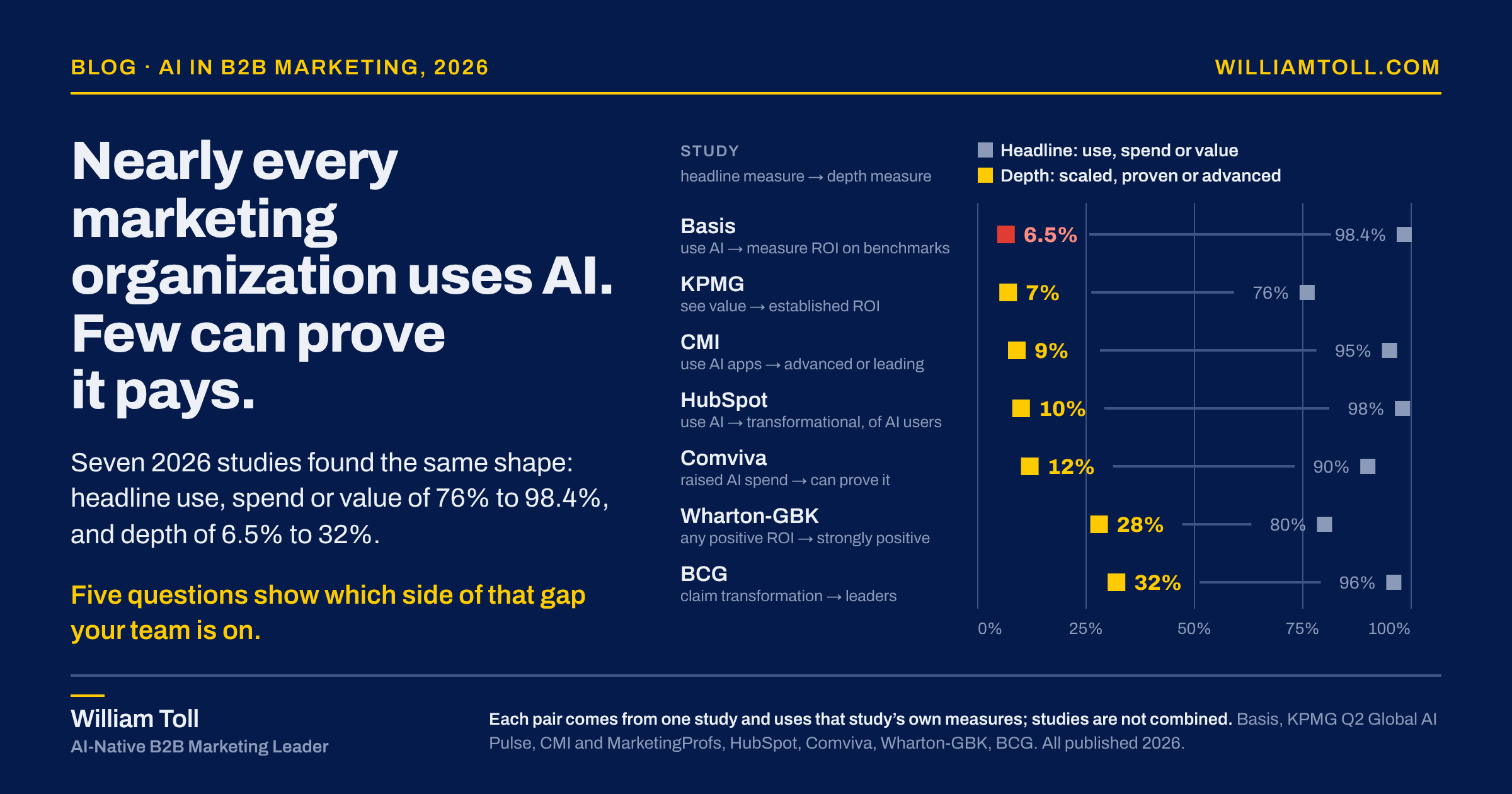
Nearly every marketing organization now uses AI, and few can prove it pays. In seven 2026 studies, headline numbers for AI use, spending or value range from 76% to 98%. Only 6.5% to 32% have scaled it, proven a return or reached an advanced stage. Organizations that report returns name an owner, standardize, redesign the work and track a business number.
Every marketing leader I talk with says their team is “doing AI.” Far fewer can tell me what AI added to pipeline last quarter.
Use is universal, depth is rare
This fall I reviewed more than 30 studies on AI in marketing for a CMO briefing, most of them published in 2026. Seven measured both a headline reading (use, spend or reported value) and how far teams have taken it, and all seven found the same shape. CMI and MarketingProfs found 95% of enterprise marketers use AI applications, yet only 7% call their implementation advanced and 2% call it leading. Basis found 6.5% evaluate AI investments against defined metrics and benchmarks. KPMG’s Q2 Global AI Pulse found only 7% of leaders across business functions report establishing ROI.
Spend has moved faster than results. CMOs now put an average of 15.3% of marketing budgets into AI, and only 30% report mature or fully developed AI readiness, according to Gartner’s 2026 CMO Spend Survey. In BCG’s 2026 CMO survey, 20% of B2B CMOs say their agentic marketing transformation already has significant, measurable revenue impact, against 31% of B2C CMOs.

Text version of this figure
| Study | Headline measure | Headline | Depth measure | Depth |
|---|---|---|---|---|
| Basis | Use AI | 98.4% | Measure ROI against benchmarks | 6.5% |
| KPMG Q2 Global AI Pulse | See value | 76% | Established ROI | 7% |
| CMI and MarketingProfs | Use AI applications | 95% | Advanced or leading | 9% |
| HubSpot | Use AI | 98% | Transformational (share of AI users) | 10% |
| Comviva | Raised AI spend | 90% | Can prove it | 12% |
| Wharton-GBK | Any positive ROI | 80% | Strongly positive ROI | 28% |
| BCG | Claim transformation | 96% | Leaders | 32% |
Hours saved is the wrong scoreboard
Most teams treat maturity as adoption: more seats, more tools, more prompts, more hours saved. That view has data behind it. Leaders in The CMO Survey credit AI with a 14.1% lift in sales productivity and a 14.6% cut in marketing overhead. CMI found 84% of enterprise marketers using AI for content say productivity has improved.
Read one line further, though. In the same CMI study, 38% report better content performance. Wharton and GBK Collective found hours saved is the KPI departments most often use to measure AI ROI, at 40%, and net-new revenue the least often, at 27%. Meanwhile about 70% of CEOs judge marketing partly on revenue growth and margin, and only about 35% of CMOs track those measures. McKinsey cites both figures from its 2025 article “The CMO’s comeback.”
Among the teams I talk with, the most mature also update their key metrics. They adjust attribution to credit influence that never shows up as a click, track prompt coverage on the buyer questions that matter most, and count citations and mentions in LLM answers next to pipeline. Measurement still trails adoption. In The CMO Survey, 41.5% of companies already use AI for generative engine optimization, and in Muck Rack’s State of PR 2026, 39% of PR professionals aren’t currently measuring GEO.
Hours saved is a fine way to start a business case. I’d never end one there, because the CFO’s next question is always what those hours bought.
What the teams getting returns do differently
Strong returns cluster around a handful of operating habits. Only one involves tools at all, and it’s about having fewer of them.
- They aim AI at growth. Departments that judge AI on a growth metric report strongly positive returns 35% of the time, against 13% for efficiency-only departments (Wharton-GBK).
- They standardize. Organizations on one approved platform report strongly positive ROI at 50%; those still experimenting, 9% (Wharton-GBK).
- They can see the cost. Organizations with full visibility of AI costs report established ROI at 15%, against 3% for the rest (KPMG).
- They put someone senior on the hook. Where the CEO is clearly accountable for AI, 14% report established ROI, against 4% elsewhere (KPMG).
- They finish the redesign. Only 20% of departments meet all three of Wharton-GBK’s workflow-transformation conditions, and 67% of those report strongly positive ROI.
- They own it. Among Bain’s B2B growth winners, 1% report shared or undefined AI ownership. Among laggards, 15% do.
One finding surprised me more than the rest. Wharton-GBK compared four ways of supervising AI. Where a person approves every AI action before it takes effect, departments achieved workflow transformation 16% of the time. That’s the lowest of the four, and it’s also the most common model, used by 48%. Departments running AI under real-time monitoring and guardrails reached 31%, though only 7% of departments work that way, and Wharton-GBK reads that small group as directional.
People belong at the decisions that matter. Put a gate with a qualified person on every key step and you’ve built in the workflow.
Score your team: five questions
Answer yes only for what runs in production today.
- Does every AI workflow in production have one named owner and an outcome metric?
- Have you rebuilt at least one workflow end to end, with handoffs between agents and people defined?
- Do you report a business number, such as pipeline, conversion or win rate, next to every productivity number?
- Are your positioning, proof and voice encoded once, in a source every AI tool loads?
- Does a named person approve everything AI-assisted that reaches a customer?
Count your yeses. Zero or one means individual use: people work with AI on their own, and the value shows up as hours. Two means assisted workflows. Three or four means a governed system. Five means you’re building a growth engine, and your next job is funding the people who run it.
My read of the studies is that most teams will land on two or fewer, and that’s worth knowing early.
Where to start
Start with your first “no.” CMOs own questions 1 and 3, because ownership and measurement need budget authority. Product marketing leaders own question 4, the messaging source every agent repeats. They share 2 and 5.
Then pick one workflow per team where a 10% improvement would change this quarter’s results. That’s Bain’s test, applied team by team. Record a baseline before you set a target, because a target announced before the baseline becomes the only number anyone remembers.
If I were starting this quarter, I’d begin with question 4. Every agent repeats whatever messaging you hand it, so a sharp position gets scaled and a vague one does too.
What this can’t tell you
My bet for 2027 is that the edge goes to teams that encode how their best marketers think, then measure it against growth. More content won’t be the edge.
Request a copy of my CMO briefing. This post draws on my briefing, AI in B2B Marketing 2026, which gives the source and page for most figures here. Request your copy. If you ran the five questions and want a second read on where to start, send me your answers too. For the team-by-team view, see my companion post.
FAQ
How many marketing teams can prove AI pays?
Few. Basis found 6.5% evaluate AI investments against defined metrics and benchmarks. KPMG found 7% of leaders report establishing ROI, and BCG found only 20% of B2B CMOs report significant revenue impact from their agentic marketing transformation.
Is hours saved a good way to measure AI ROI?
On its own, no. Wharton and GBK Collective found hours saved is the KPI departments most often use to measure AI ROI, at 40%, while net-new revenue is used least often, at 27%. About 70% of CEOs judge marketing partly on revenue growth and margin, according to McKinsey’s 2025 research, so pair every hours number with a pipeline, conversion or win-rate number.
Sources
- CMI and MarketingProfs, Enterprise Content and Marketing Trends: Insights for 2026
- Basis, AI and the Future of Marketing: 2026 Edition
- KPMG, Global AI Pulse Q2 2026 press release and brochure
- Gartner, 2026 CMO Spend Survey press release
- BCG, Moving the Agentic Marketing Transformation from Illusion to Reality
- The CMO Survey 2026, Highlights and Insights, pp.22, 25
- Wharton Human-AI Research and GBK Collective, The Adaptive Advantage
- McKinsey, From anxiety to advantage, footnote 4, citing “The CMO’s comeback” (2025)
- Bain, AI Won’t Transform Your Go-to-Market Until You Transform the Work
- Muck Rack, State of PR 2026, 971 usable responses, May 14 to June 12, 2026
- HubSpot, The State of AI in Marketing 2026 (vendor survey of 1,754 marketers, June 2026)
- Comviva, Global CMO Survey 2026 press release (200+ retail, ecommerce and telecom executives)
Topics: ai-native-marketing, marketing-measurement, product-marketing, b2b-research. How I research and write these posts: editorial standards.