Bottom line
Use AI for the routine work around each analyst interaction, never for the relationship. Axiomarq's six Claude skills draft briefing requests, prep docs, debriefs, workbacks, plans and reports, and people approve and send everything. Executives walk into briefings prepared, product leaders get analyst feedback as tickets, sales gets talking points within a day, and every claim an analyst hears traces to evidence.
Analyst relations runs on work nobody sees: briefing requests, prep docs, debriefs, follow-ups, calendars and reports. When that work slips, executives walk into briefings cold, product leaders hear analyst feedback weeks late, and analysts hear claims nobody can prove. I built Axiomarq, a set of Claude skills, to take that routine work off an AR team's plate, whether you're an in-house AR lead or a consultant running several clients. This guide shows what AI for analyst relations looks like in practice: the outcomes to expect, who benefits, the guardrails, and how Claude skills compare with the analyst relations tools you may already use.
What a smoother analyst program looks like
Start with the outcomes, then pick the tools. Here's what the skills aim to produce, and the measure that shows each one:
| Outcome | What changes | How you'll know |
|---|---|---|
| Executives walk in ready | A one-page prep doc for every briefing, with the hardest likely questions first | Prep delivered on time, every briefing |
| Nothing slips | Every promise to an analyst becomes a follow-up with an owner and a date | Follow-ups closed on time |
| Claims you can defend | Every message in a deck carries its proof, and gaps show as [confirm], never a guess | Share of claims tied to evidence |
| More listening, less pitching | Each briefing gets an inquiry before and after it | Inquiry share of all interactions |
| No evaluation-season scramble | Every firm date works back to internal deadlines and owners | Internal deadlines met |
| Product hears the market | Analyst feedback lands as product tickets within a day | Feedback items logged per call |
| Sales says the right thing | A short note on what to say, and not say, about each analyst's view | Analyst-influenced pipeline |
| Leaders see outcomes | Reports open with outcomes, and every number traces to a record | Perception and placements over two cycles |
Analysts notice when that work is missing.
Most of that gap is a workload problem. A team racing to finish a deck has no time to plan the inquiry that would have taught it something.
What Axiomarq is: Claude skills for analyst relations
Axiomarq is six Claude skills, an Engage Tracker and two setup kits. Axiomarq is a made-up name I gave the project, not a company. A Claude skill is a saved set of instructions, defaults and checks that Claude follows for one job. Each Axiomarq skill drafts and checks; people decide and send.
| Skill | What it drafts | Who feels it most |
|---|---|---|
| ar-calendar-workback | Internal deadlines, owners and calendar holds from every analyst-firm date | AR lead, executives, communications |
| analyst-engagement-planner | Six months of analyst touches by tier, around launches, evaluations, quiet periods and paid entitlements | AR lead, product, sales |
| analyst-call-prep | Briefing requests, one-page prep docs, ranked inquiry questions and deck checks | Executives, product leaders, product marketing |
| analyst-debrief | A debrief record, follow-ups, product feedback, a summary for each audience and a thank-you note | Executives, product, sales, product marketing |
| ar-engagement-tracker | Keeps the Engage Tracker current from Outlook or Google calendars and shared folders | AR lead or consultant |
| ar-program-reporting | Everything from the weekly AR update to the annual board review, outcomes first | CMO, CEO and board |
Four rules hold in every skill:
- Drafts only. No skill sends email, calendar invites or messages.
- No firm research in Claude. Skills never paste, upload or summarize Gartner or Forrester research, and never use anyone's firm login.
- No inquiry recordings. For Gartner and Forrester inquiries, skills work from typed notes.
- Sourced or flagged. Every number traces to a record; anything missing gets a [confirm] flag.

What each group gets from the program
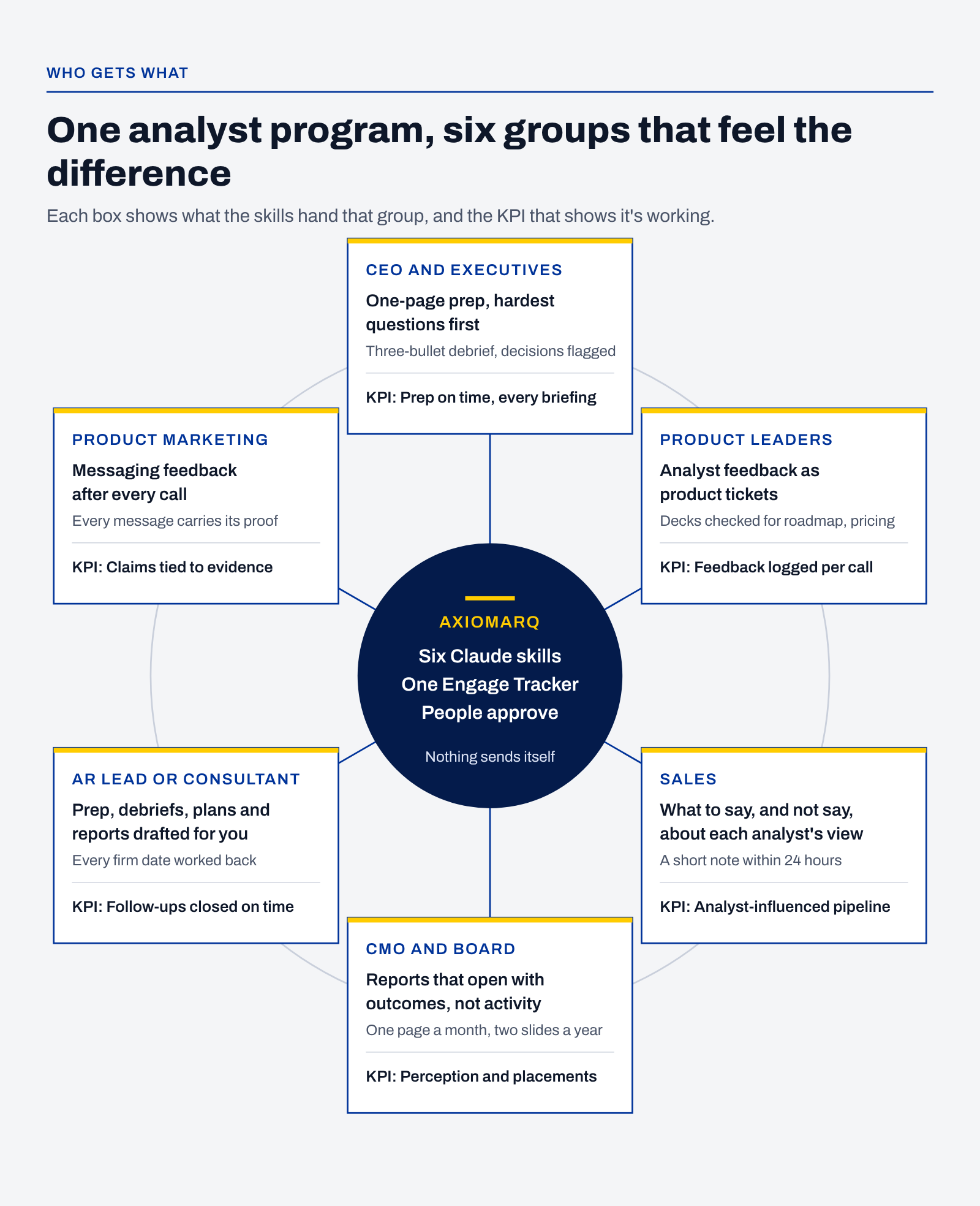
AR teams buy tools for themselves, but the people who feel the difference sit across the company.
Text version of this figure
| Group | What they get | KPI |
|---|---|---|
| CEO and executives | One-page prep with the hardest questions first; a three-bullet debrief with decisions flagged | Prep on time, every briefing |
| Product leaders | Analyst feedback as product tickets; decks checked for roadmap and pricing | Feedback logged per call |
| Sales | What to say, and not say, about each analyst's view, in a short note within 24 hours | Analyst-influenced pipeline |
| CMO and board | Reports that open with outcomes: one page a month, two slides a year | Perception and placements |
| AR lead or consultant | Prep, debriefs, plans and reports drafted; every firm date worked back | Follow-ups closed on time |
| Product marketing | Messaging feedback after every call; every message carries its proof | Claims tied to evidence |
CEOs and executive spokespeople: briefed, never surprised
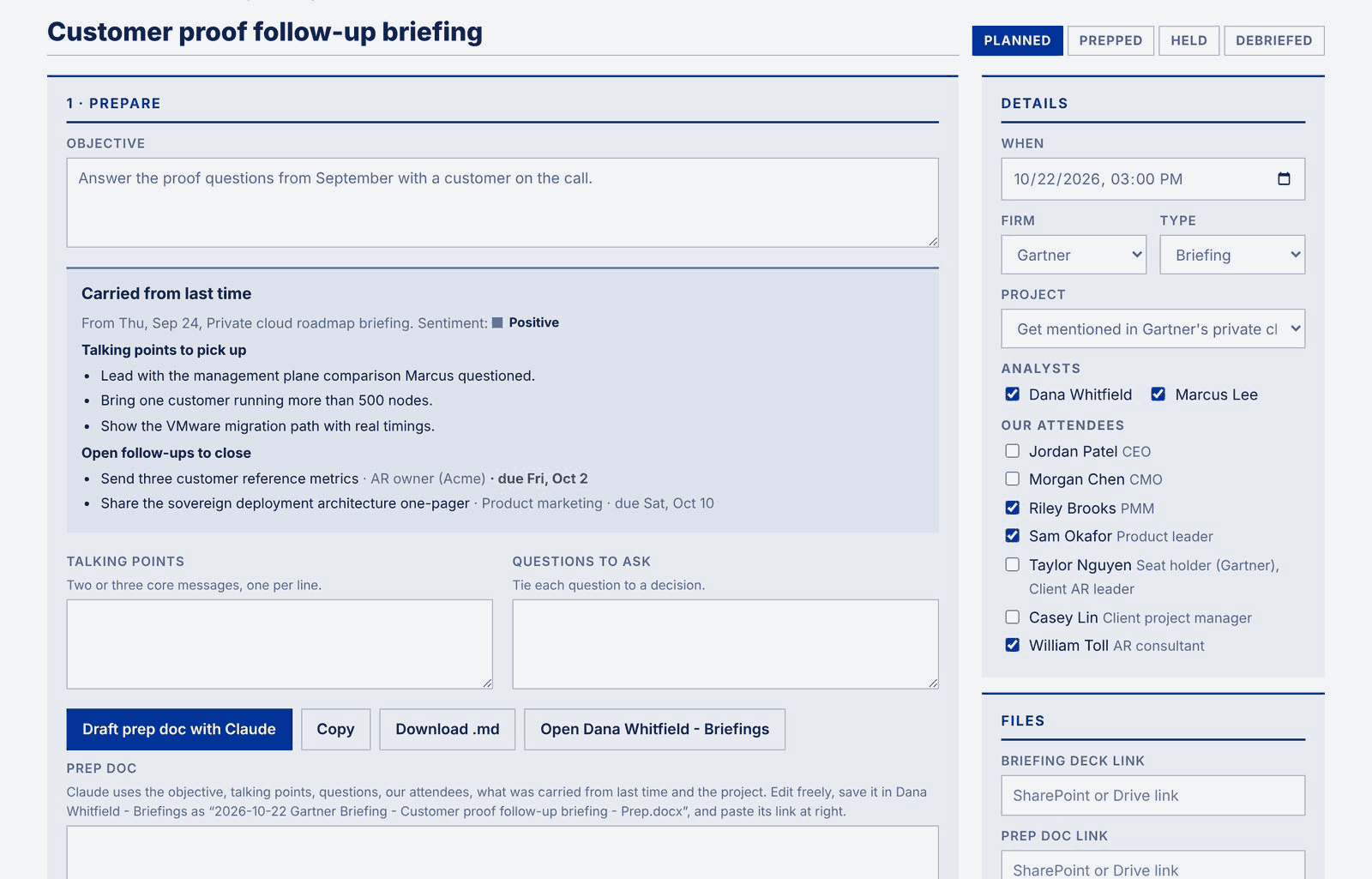
- A one-page prep doc for every briefing, ready five business days ahead: the analyst's background and recent public work, what happened last time, open follow-ups, two or three messages with their proof, questions to ask, likely analyst questions with the hardest first, a run of show and what not to say.
- No last-minute decks. Briefing requests go out three to four weeks ahead, and the deck or pre-read reaches the analyst 48 hours before, at 9 to 12 slides.
- Three bullets after the call, plus any decision needed, instead of a recap meeting.
- Reports in the format leaders read: a one-page monthly report for the CMO, a quarterly review for the executive team and two slides a year for the CEO and board.
Outside the company, analysts meet an executive who knows who said what last time, and what the company promised. That's the smoother experience analysts remember.

Product leaders: market feedback without the hallway game
- Analyst feedback as product tickets. Debriefs draft roadmap feedback and feature questions as tickets for a product tool such as Jira or Productboard within a day, not as a slide at next quarter's review.
- Decks that protect the roadmap. Deck checks flag unannounced pricing, customer names without written approval and roadmap beyond two quarters unless the slide says NDA.
- Demos rehearsed, not improvised. Before an evaluation briefing and demo, the workback books a dry run with spokespeople three business days ahead.
- Their requests planned, not squeezed in. Requests for analyst time from product and sales go into the six-month plan, around launches and quiet periods.
Product marketing and sales: the same story, told with proof
- Product marketing gets messaging and positioning feedback after every call, and every prep doc carries two or three core messages, each with its proof.
- Sales gets a short note, drafted within 24 hours, on what to say, and not say, about each analyst's view. Inquiry summaries go only to the people named for them.
- Both see the program's effect on deals: reports include analyst-influenced pipeline, read from the CRM without changing a record.
AR leads and consultants: hours back, one standard
- Drafts, not blank pages, for every request, prep doc, debrief, plan and report.
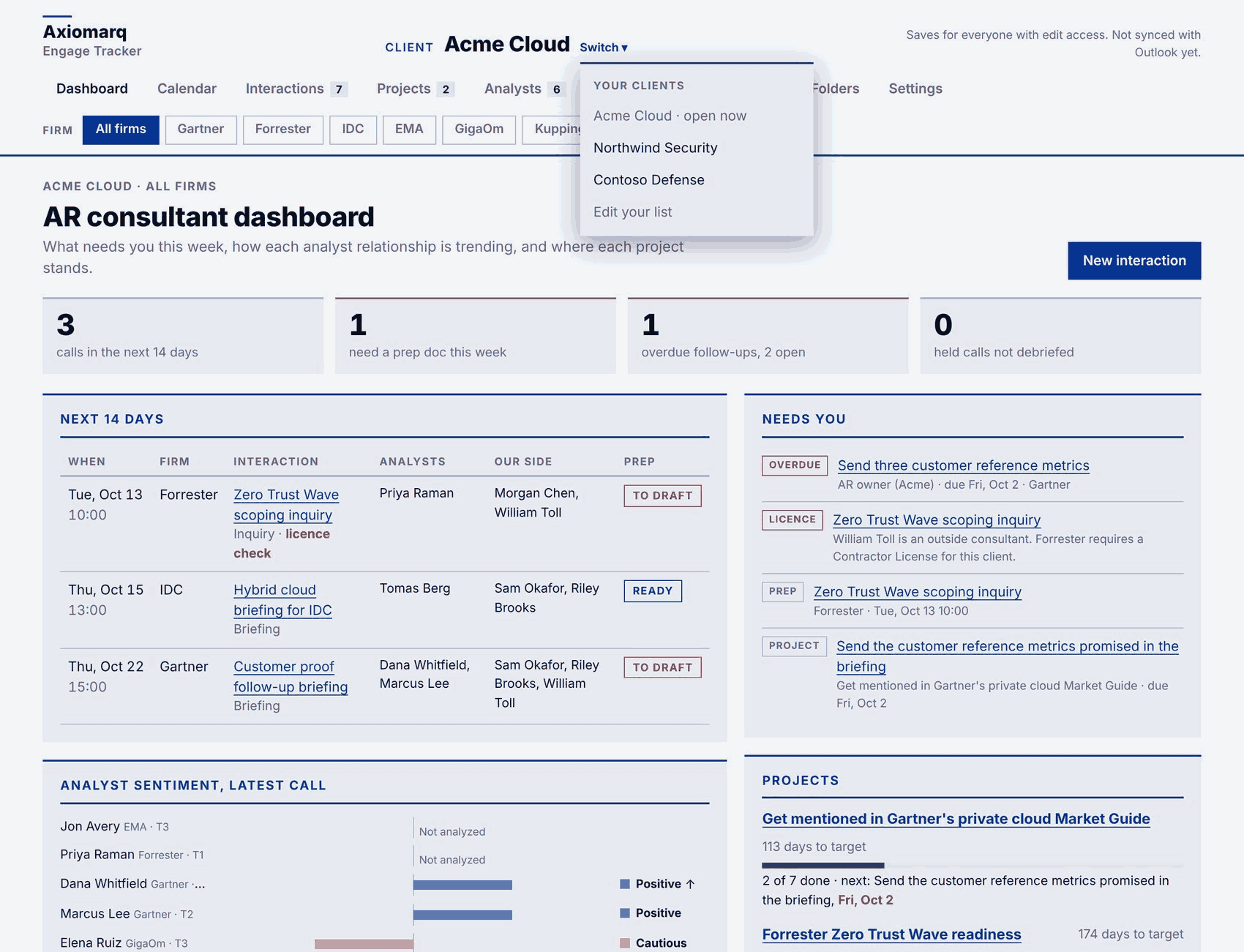
- Nothing slips. Ask the tracker what needs you and it lists calls in the next 14 days, calls without a prep doc, overdue follow-ups by owner and licence problems before a call.
- One method for every client. Consultants get the same standard across clients, with each client's material kept apart.
How the skills work together: one loop per analyst
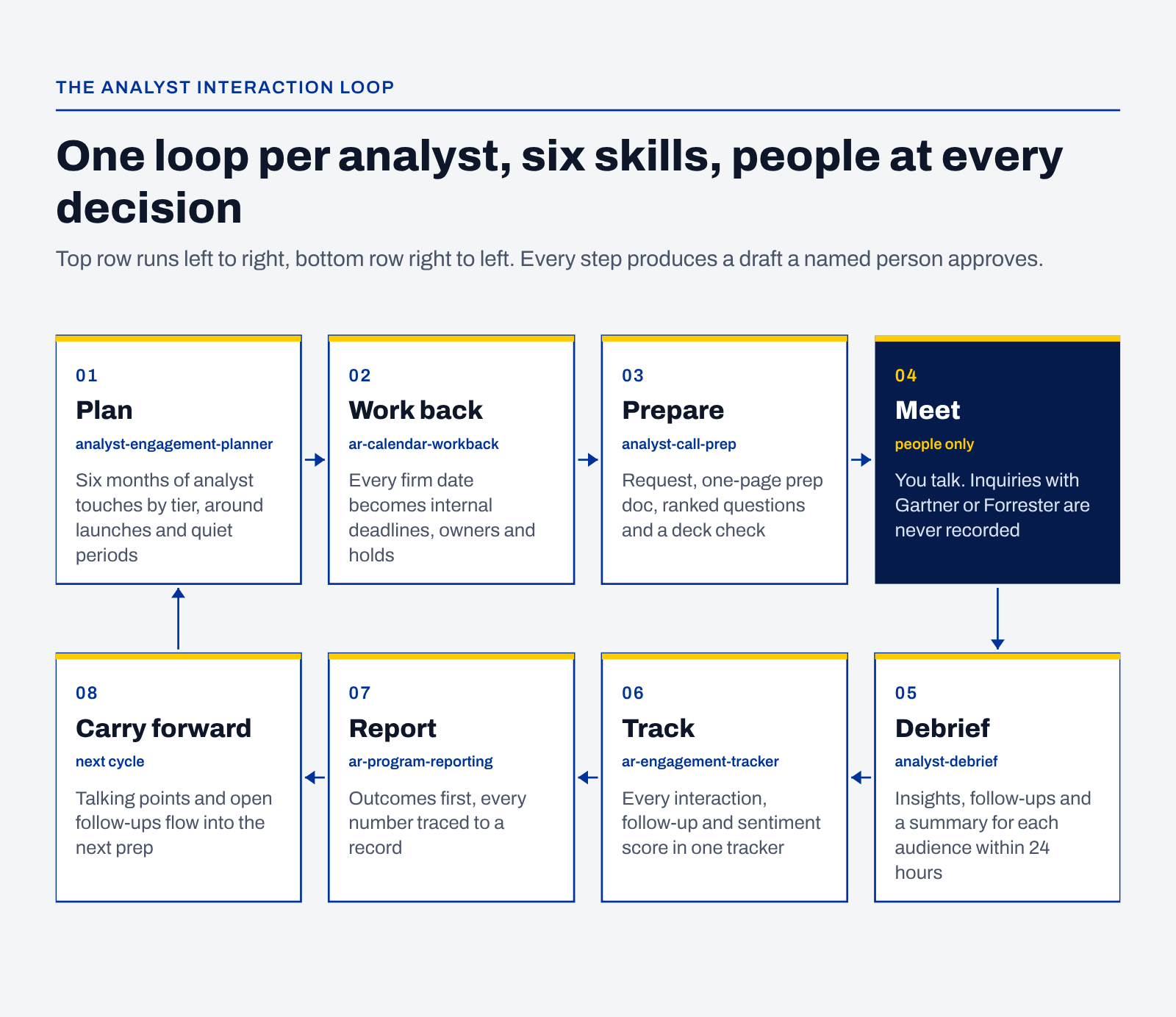
Each analyst relationship runs as a loop. What you learn in one call becomes the prep for the next.
Text version of this figure
| Step | Skill | What happens |
|---|---|---|
| 1. Plan | analyst-engagement-planner | Six months of analyst touches by tier, around launches and quiet periods |
| 2. Work back | ar-calendar-workback | Every firm date becomes internal deadlines, owners and holds |
| 3. Prepare | analyst-call-prep | Request, one-page prep doc, ranked questions and a deck check |
| 4. Meet | People only | You talk; inquiries with Gartner or Forrester are never recorded |
| 5. Debrief | analyst-debrief | Insights, follow-ups and a summary for each audience within 24 hours |
| 6. Track | ar-engagement-tracker | Every interaction, follow-up and sentiment score in one tracker |
| 7. Report | ar-program-reporting | Outcomes first, every number traced to a record |
| 8. Carry forward | Next cycle | Talking points and open follow-ups flow into the next prep |
Default lead times, which the setup kit lets you change:
| Interaction | Request sent | Prep doc ready | Pre-read or deck sent |
|---|---|---|---|
| Vendor briefing | 3 to 4 weeks before | 5 business days before | 48 hours before |
| Inquiry | 1 to 2 weeks before | 2 business days before | Not needed |
| Advisory or strategy session | 6 weeks before | 5 business days before | 1 week before |
| Analyst event one-on-one | When booking opens | 3 business days before | Not needed |
Guardrails that protect executives and analyst relationships
AR runs on trust, so the skills are strict about what they won't do:
- Licensed research stays out. Gartner's usage policy bars using its content as input into generative AI and permits no derivative use of it through AI. Skills work from the AR lead's own notes instead.
- People send everything. Every request, thank-you and report is a draft until a named person sends it.
- No guessing. A missing date, quote or number shows as [confirm], so nobody repeats an invented fact to an analyst.
- Sensitive views stay inside. Reports never put an analyst's name next to negative sentiment beyond marketing leadership.
Firm policies change without notice, so check each firm's current terms and your contracts before relying on a rule built into a skill. IT and security teams get a full security section in the documentation, described below.
In-house or consultant: pick your edition
Both editions hold the same six skills with the same names, so you install one.
| Consultant edition | In-house edition | |
|---|---|---|
| For | An AR consultant or agency running programs for several clients | An AR lead running the program for one company |
| Scope | One tracker per client, with clients kept apart | Your company's contracts, internal audiences and AI policy |
| Debrief summaries | For each client's team | For executives, product, sales and product marketing, with product feedback drafted as tickets |
| Reporting | Client program reports | Leadership and board reports, with analyst-influenced pipeline |
| Setup | Skills Build Kit: 131 questions across four roles | In-House AR Skills Kit: 48 questions, about 45 minutes |
Claude skills or analyst relations software?
Analyst relations software gives you an analyst database, interaction tracking, reporting and growing AI features. Axiomarq doesn't replace a curated analyst database. Instead, it puts your AR method inside the Claude you already use, working from your own calendar, folders and approvals.
Homegrown AR tools have a poor record, and that's the fair objection. In a 2021 paper published by an AR software vendor, Peggy O'Neill describes a custom tool at Cisco so unpopular that over time no one was using it, and notes that custom solutions often struggle with support and upgrades. Its publisher sells AR software, so weigh that accordingly. Axiomarq's answer is defaults that work on day one, a setup kit instead of a development project, and versioned releases. Whether that holds up over years is still to be proven.
Built from eight AR programs
Early feedback from an in-house AR expert who used to work with me, after receiving the in-house edition: "I owe you big on this artifact."
How to start
- Pick your edition: in-house for one company, consultant for several clients.
- Answer the setup kit. Your answers set the company, products, contracts, seat holders, approvers and lead times the skills use.
- Install the six skills in Claude with code execution switched on, or as a plugin in Claude Code or Cowork.
- Run each skill on one real, low-stakes task first, such as debriefing last week's call.
- Measure a baseline of hours per interaction, follow-up closure and report time on recent work, then compare at day 30 and day 90.
One research report or survey can feed a whole year of analyst conversations. My guide to optimizing B2B survey and research report assets covers the evidence discipline analysts reward, and my map of AI use cases by marketing team shows where AR fits beside PR, product marketing and sales.
Where this can fall short
Documentation for AR, IT, security and finance teams
Every share pack includes the Axiomarq Reference Architecture: 86 pages in 11 parts, as a PDF and a web page, with the source behind every external fact. Documented in full: the complete design of 23 skills and six scheduled agents, of which the share pack ships the first six skills. Each reader gets a reading path:
| Part | What it covers | Who reads it first |
|---|---|---|
| A. Overview and value | Executive summary, roles, eight business benefits and their measures, tiers, eight operating rules | CMO, AR leader |
| B. System architecture | One-page architecture, modules, delivery models, where data lives, the Engage Tracker, hosting options | AI architect, Marketing Ops |
| C. Gates and human approval | 13 automatic gates, seven points where a named person decides, decision rights | AR leader, legal |
| D. Agents | Six scheduled agents and two helpers, what each may touch and how they run | AI architect |
| E. Skills | All 23 skills, the Gartner policy map, the research-use check, how each skill is built and tested | AR lead, program manager |
| F. Connectors | Google Workspace, Microsoft 365, Slack, Outlook and SharePoint, with scopes | Marketing Ops, IT |
| G. Licensing and cost | Claude plans by tier, token costs, total monthly cost with assumptions shown | Finance |
| H. Use cases | Prompts, outputs and a day in the life at each tier | AR consultant, AR lead |
| I. Build kit | The setup questions that tailor the skills, and the in-house edition | AR lead |
| J. Security and privacy | Trust zones, identity and data controls, Engage Tracker security, threat model, guardrails as code | IT and security |
| K. Delivery | An 18-week part-time timeline, steps by phase, risks and decisions, sources | Program owner |
For IT and security reviewers, part J answers the first questions:
- Trust zones. Six zones with rules at each boundary, and one rule above the rest: nothing that reads untrusted content holds a tool that can send, share, delete or publish.
- Identity and access. One service identity per client, with read-only scopes plus one drafts folder, and approval prompts kept on for send, share, move and trash.
- Data and retention. What Anthropic's commercial terms say about training and retention, and which controls need an Enterprise plan.
- Engage Tracker isolation. One tracker and database per client, Microsoft 365 read tools only, and a full JSON and CSV export at exit.
- Threat model. Eleven threats, from prompt injection to cross-client leakage and licensed-research misuse, each with its controls and an owner for what remains.
- Guardrails as code. Settings, a hook and evals that test the rules instead of trusting a prompt.
Get the skills pack and documentation
Contact me for the share pack and its documentation. You'll get both editions of the six skills, the Engage Tracker, the In-House AR Skills Kit, the consultant Skills Build Kit and the 86-page reference architecture. Tell me whether you run AR in-house or as a consultant, and whether your IT or security team will review it first. For help setting it up across a program, see my advisory work.
FAQ
How can AI help analyst relations?
AI helps most with the routine work around each analyst interaction: briefing requests, one-page prep docs, debriefs, follow-ups, calendars and reports. People should still own the relationship, every word an analyst receives and every send. Keep licensed research out of the AI tool: Gartner's usage policy bars using its content as input into generative AI.
What is analyst relations software?
Analyst relations software helps AR teams track analysts, interactions, evaluations and results. AR software platforms add an analyst database and reporting. Claude skills such as Axiomarq take a different route: they put your AR method inside Claude and draft the work from your own calendar, folders and records.
Can you use Gartner research with Claude or ChatGPT?
No. Gartner's usage policy bars using its content as input into generative AI and permits no derivative use of it through AI. Check every firm's current terms and your contract before using any research with an AI tool. Axiomarq's skills never paste, upload or summarize firm research; they work from your own notes.
How do you prepare an executive for an analyst briefing?
Give them one page, five business days ahead: the analyst's background and recent public work, what happened last time, open follow-ups, two or three messages with their proof, questions to ask, the hardest likely questions first and what not to say. Send the deck or pre-read to the analyst 48 hours before the briefing.
How do you measure analyst relations?
Lead with outcomes: perception movement by analyst, evaluation status and placements, entitlements used against what's paid for, analyst-influenced pipeline, and LLM answers and citations that mention you. Then track operating health: follow-ups closed on time, prep delivered on time and the share of interactions that are inquiries.
What should IT and security teams review before an AR team uses Claude?
Review where data goes and stays, who the system acts as, and what it can do without a person. Axiomarq's reference architecture covers trust zones, identity and read-only scopes, data retention under Anthropic's commercial terms, isolation between clients, an eleven-threat model and guardrails tested as code. Check your own Claude plan and contract terms as well.
What's the difference between the in-house and consultant editions?
Both editions hold the same six Claude skills. For a consultant, each client's material stays apart and reports go to client teams. For an in-house AR lead, the skills add your company's contracts, internal audiences and AI policy, draft analyst feedback as product tickets, and report to leadership and the board with analyst-influenced pipeline.
Sources
- Spotlight, The 2026 Analyst Survey Report: What You're Leaving On the Table, August 27, 2026 (175 analysts, fielded June to August 2026; Spotlight sells AR services and software)
- Gartner Usage Policy
- Spotlight, The Complete Guide to Analyst Relations Software in 2026, November 10, 2025
- Peggy O'Neill, In Search of Efficiency, 2021 (published by an AR software vendor)
- Elisity Named a Strong Performer in The Forrester Wave: Microsegmentation Solutions, Q3 2024, Business Wire, August 28, 2024
Topics: analyst-relations, governed-agents, claude-code, ai-native-marketing, cybersecurity-marketing. How I research and write these posts: editorial standards.