Bottom line
In the B2A economy, agents become the main users of B2B software, from cybersecurity platforms to the apps marketing teams run on, and they act on whatever data they reach. Buyers' agents judge you from your site, docs, reviews and coverage, while your own agents sell from your CRM, calls, messaging and case studies through MCP servers. Teams that run data hygiene as a revenue program, with owners, provenance and one source of truth, will win both.
Olivia Moore and Justine Moore of Andreessen Horowitz (a16z) just published Welcome to the B2A Economy, and I think it's the defining blog post of our time. Their argument opens with one line: "The primary users of the Internet are no longer human." My B2B read is simpler and less comfortable: in the B2A (business-to-agent) economy, agents become the main users of your software and your buyers' software, they act on whatever data they reach, and most B2B data isn't ready for them.
What a16z gets right
Moore and Moore argue that agents are moving from answering questions to finishing tasks, so they'll increasingly pick products and decide where money goes. They expect generative engine optimization to stretch from discovery into evaluation and execution of a purchase or signup. They describe connectors, plug-ins and MCP (Model Context Protocol) servers as an app store for agents, and they say businesses that spent years blocking bots now have to compete for them.
Olivia Moore summed up the thesis in her post announcing the piece: agents are the primary users of the internet and soon "the primary customers for every product." Most of their examples are consumer. I think the line lands hardest in B2B, and that's the part of the piece B2B leaders should read twice.
AI agents are becoming the main users of B2B software
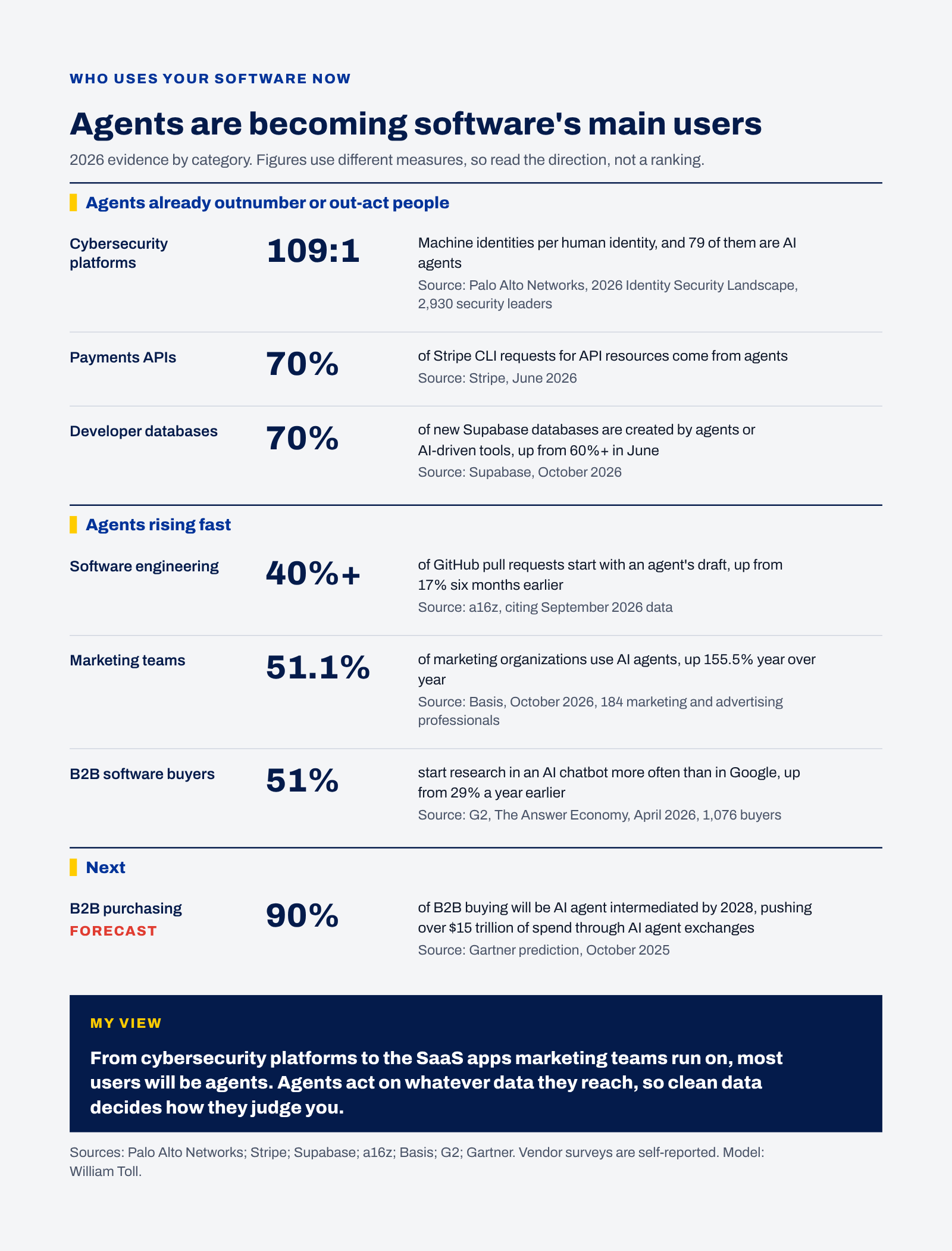
Look across B2B categories and the direction is the same everywhere. Agents already outnumber or out-act people in some categories, and they're the fastest-growing users in the rest.
Cybersecurity got there first. Palo Alto Networks' 2026 Identity Security Landscape, a survey of 2,930 security leaders, found machine identities outnumber human identities 109 to 1, and the full report counts 79 AI agent identities in that ratio for every person. So the identity and access platforms CISOs buy already govern far more agents than employees.
Developer infrastructure followed. Stripe says agents now make up nearly 40% of its documentation traffic and 70% of its CLI requests for API resources. Supabase says agents or AI-driven tools create 70% of its new databases, up from more than 60% in June. And a16z reports that more than 40% of GitHub pull requests now start with an agent's draft, up from 17% six months earlier.
Marketing software is next. Basis found that 51.1% of marketing organizations now use AI agents, up 155.5% year over year. HubSpot CTO Dharmesh Shah says the company will accelerate what he calls "Headless HubSpot," CX Today reports. Info-Tech Research Group places that inside a broader headless CRM trend: Salesforce is going headless so users can reach its processes from their conversational AI tool, and Klaviyo is exposing more than 260 MCP tools and 490 APIs.
Some teams are already there. Jason Lemkin wrote on November 15 that SaaStr's CRM is fully headless, used by agents rather than people, and that SaaStr dropped traditional marketing automation software in the previous 60 days.
Looking ahead, Gartner predicts that by 2028, 90% of B2B buying will be AI agent intermediated, pushing more than $15 trillion of spend through AI agent exchanges.
Put the categories side by side and the shift is plain: from cybersecurity platforms to marketing apps, agents are on their way to becoming the majority of users.
Text version of this figure
Agents already outnumber or out-act people:
- Cybersecurity platforms: 109 machine identities per human identity, 79 of them AI agents (Palo Alto Networks, 2026 Identity Security Landscape, 2,930 security leaders)
- Payments APIs: 70% of Stripe CLI requests for API resources come from agents (Stripe, June 2026)
- Developer databases: agents or AI-driven tools create 70% of new Supabase databases, up from more than 60% in June (Supabase, October 2026)
Agents rising fast:
- Software engineering: more than 40% of GitHub pull requests start with an agent's draft, up from 17% six months earlier (a16z, citing September 2026 data)
- Marketing teams: 51.1% of marketing organizations use AI agents, up 155.5% year over year (Basis, October 2026, 184 professionals)
- B2B software buyers: 51% start research in an AI chatbot more often than in Google, up from 29% a year earlier (G2, April 2026, 1,076 buyers)
Next, a forecast:
- B2B purchasing: 90% of B2B buying will be AI agent intermediated by 2028 (Gartner prediction, October 2025)
My view: from cybersecurity platforms to the SaaS apps marketing teams run on, most users will be agents, and clean data decides how they judge you.
Here's why that changes the data conversation. A person using your product skims past a stale field, a duplicate record or a product name that changed last quarter. An agent acts on it. When agents become the main users of security platforms, CRMs, marketing automation, analytics and content systems, each of those products is only as good as the data inside it. Clean data stops being an ops chore and becomes the interface.
Two sets of agents, one data problem
B2B gets the B2A shift twice.
Outside your walls, your buyer's agents read your website, docs, pricing logic, security pages, reviews, analyst notes and press coverage, then compare you with everyone else in the category. In G2's Answer Economy research, 51% of B2B software buyers now start research in an AI chatbot more often than in Google, and 69% ended up choosing a different vendor than they first planned because of a chatbot recommendation. G2 sells AI-visibility products, so read those numbers as vendor research.
Inside your walls, your own agents prospect, prep calls, write emails, draft content and update the forecast from your CRM, call recordings and messaging. Both kinds of agent repeat what they find. Neither knows which of your three product descriptions is current.
People still check the work. Gartner found that 69% of B2B buyers prefer to validate AI-generated insights with sales reps, in a survey of 645 buyers fielded in August and September 2025. So the agent's answer and the rep's answer have to match, and they only match when both draw on the same clean source.
HubSpot just told you where the value goes
On November 12, HubSpot named co-founder Brian Halligan CEO again, replacing Yamini Rangan, in what the company's announcement calls a refounding. In that release Halligan said chapter three is "building the customer relationship harness." On X he went further, posting that HubSpot is now the Customer Harness Company. CMSWire notes HubSpot's stock was down about 47% year over year when the change landed.
Melissa Rosenthal read the move well. In AI, a harness is the scaffolding of tools and memory around a model, so HubSpot wants to be the layer agents plug into, and she argues the seat-priced CRM is turning into plumbing. In a follow-up post, Halligan said HubSpot inside Claude is "on fire." That's a CRM founder celebrating usage that happens inside an LLM client rather than in his own screens.
I agree with Rosenthal, and I'd push one step further. When the CRM becomes plumbing, whatever flows through the pipes becomes the asset. CMSWire also notes that HubSpot reversed a July terms change that would have shared customers' enrichment data with other accounts on an opt-out basis. Data is strategy now, and whoever governs it governs trust.
HubSpot isn't alone, either. Adam Schoenfeld tracked agent harness claims across go-to-market tech and found nine other vendors using the word between June and November 2026, from Gong's "Revenue Harness" to Unify, Profound, Rox, Optimizely, Salesforce, Apollo, Hightouch and Phave, with Clay building the same layer without calling it one. His read is that an agent is a harness plus a model, so vendors will compete on how they deliver the harness.
He sees three camps. Model labs' own apps are general harnesses, and some expect them to win sales and marketing outright. GTM vendors are betting on domain-specific harnesses from four directions: CRMs, sales intelligence and workflow tools, agent-native startups and marketing platforms. Technical teams will build their own. His conclusion is the honest one: there's no playbook or best practice yet.
Adam also quotes Kyle Norton's definition for GTM: "The harness is the system around the model," connecting it to your tools, prompts, files, databases, permissions, workflows and state. Files, databases and state are your data, and the rest only works if that data is clean. Whichever harness your team picks, and you may switch more than once, clean, owned data is the one bet that pays off with every harness.
Jason Lemkin's working definition at SaaStr makes the same point: whoever holds "the most complete context on the customer and the business" becomes the harness.
Ten data sources your agents will consume
Here's the inventory I'd expect every B2B go-to-market team to expose to agents through read-only MCP servers over the next year, and the hygiene test each one should pass before anything connects to it. MCP, the Model Context Protocol, is an open standard for connecting AI applications to business systems.
| Data source | What agents use it for | Hygiene test before you connect it |
|---|---|---|
| Published content: site, blog, docs, support | Answers, citations, evaluation | One product name and one-line description everywhere; every claim dated |
| Messaging house: positioning, pillars, proof | Every draft, deck and email | One versioned file wins over every deck; each claim has a source, owner and expiry date |
| Sales call recordings and transcripts | Buyer language, objections, coaching | Transcripts actually reach the CRM; consent recorded; off-the-record passages excluded |
| CRM | Account context, routing, forecasts | No duplicate contacts; loss reasons filled; required fields enforced at entry |
| Customer usage data | Expansion signals, account health, proof | One definition per metric; personal-data rules applied before any agent reads it |
| Case studies and references | Proof agents cite and sellers repeat | Clearance status, approved wording and allowed links on file for each customer |
| Marketing attribution sources | What to fund next | First touch stamped; no free-text orphans; influence defined with sales |
| SEO, AEO and GEO data | What buyers ask and where you show up | Versioned buyer prompt set; untested prompts never counted as misses |
| Earned media, analyst and review coverage | Third-party proof agents trust | One current boilerplate; coverage tracked in LLM answers and citations |
| Product specs, integrations, pricing logic, security docs | Evaluation and execution | Current, machine-readable and owned by product, not by whoever last edited the PDF |
Row nine matters more than most teams think. Muck Rack's Generative Pulse found that earned media accounts for 84% of AI citations across more than 25 million links in its May 2026 edition, using a broad category that covers journalism, research, government and third-party corporate content. That's why PR and analyst relations belong in a data conversation, and why the AR skills I built make every analyst-facing claim trace to evidence.
Data hygiene is a revenue program, not a cleanup ticket
Most B2B teams aren't ready. In Bain's B2B Growth Agenda 2026, 60% of 1,125 sales and marketing leaders said their data foundation wasn't robust, their technology wasn't ready, or both. Bain also warns that launching AI on data as it stands risks inaccuracy.
Picture what an agent does with an ordinary CRM: two contacts with different titles for the same buyer, a lost deal with no loss reason, a call whose transcript never synced. A person shrugs and asks a colleague. An agent writes the email, scores the account or updates the forecast anyway.
Six habits from my own practice turn hygiene from a project into an operating discipline:
- One source of truth per domain. A versioned text file wins over any deck, and the deck gets rebuilt from it.
- Claims as inventory. Every number carries a source, an owner and an expiry date, and an expiring claim opens a review on every asset that uses it.
- Fix the source, not the output. When an agent gets something wrong, file the correction against the knowledge base it read. Corrections compound; edits to drafts don't.
- Primary source or nothing. Anything an agent can't locate gets marked not found, never filled with plausible text.
- Read-only by default. Agents read through approved connectors, one publishing service holds write access, and no agent sends email.
- Untested isn't zero. A buyer prompt nobody has run yet is a gap in your data, not a miss.
What I'd do in the next 90 days
If you scored your team with my five maturity questions, question four is where this starts.
- Inventory the ten sources above and name one owner for each, with authority to say no.
- Turn the messaging house into one versioned file with a claims ledger beside it.
- Fix the three CRM gaps agents trip on first: transcript sync, loss reasons and duplicate contacts.
- Connect read-only MCP servers to content, CRM and call recordings, and keep a single write path.
- Publish machine-readable proof: specs, integrations, security answers and pricing logic.
- Test your top 50 buyer questions across the major engines every month, and record who gets cited and how you're described.
- Report agent-referred sessions and citation rate next to pipeline, never instead of it.
Where this can fall short
a16z is right that businesses now compete for agents as customers. In B2B, agents are becoming the users too, and you win them before they arrive, in the systems your team keeps clean, owned and dated. If you want a second read on where your data stands, book 30 minutes with me. For the team-by-team view, see AI use cases by marketing team.
Further reading on HubSpot and the B2A economy
- HubSpot's announcement: HubSpot Announces Leadership Transition, filed with the SEC on November 12, 2026
- Halligan's posts on X: back as CEO, now the Customer Harness Company and the new tagline, November 12, 2026
- SaaStr: HubSpot Is Refounding as the "Customer Harness Company." Here's What That Means for Us, Right Now, in November 2026, by Jason Lemkin
- CMSWire: Brian Halligan Returns as HubSpot CEO, Replacing Yamini Rangan, by Dom Nicastro
- CX Today: Halligan Returns to HubSpot, Calling It a Refounding, by Rob Scott
- WebProNews: Brian Halligan Returns as HubSpot CEO, Calling It a Refounding
- Adam Schoenfeld on LinkedIn: nine other GTM vendors now selling an agent harness, with his three camps of harness bets
- Melissa Rosenthal on LinkedIn: what a harness means for the CRM
- James Gill: Has the business world gone mad?, a skeptical read of the harness tagline
- a16z: Welcome to the B2A Economy, by Olivia Moore and Justine Moore, and Olivia Moore's post introducing it
- PPC Land: a16z says firms must court AI agents as agent traffic grows 8x in two months
- FourWeekMBA: a16z Agent Economy Map: 111 Infra Logos vs 81 Consumer Apps
- Fast Company: Welcome to B2A, or business-to-agent marketing, by Stuart D'Rozario
FAQ
What is the B2A economy?
B2A, or business-to-agent, describes an economy in which AI agents become the main users of the internet and increasingly decide which products to use and buy. a16z's Olivia Moore and Justine Moore argue that businesses treating agents as first-class customers can grow, while businesses that keep blocking agents risk falling behind.
Will AI agents become the main users of SaaS products?
In several B2B categories they already are. Palo Alto Networks found machine identities outnumber human identities 109 to 1, and Stripe says agents make 70% of its CLI requests for API resources. Gartner predicts 90% of B2B buying will be AI agent intermediated by 2028, so marketing and sales software is heading the same way.
What does B2A mean for B2B marketing?
For B2B marketing, B2A means two audiences of agents. Buyers' agents research and shortlist vendors from public content, docs, reviews and coverage, and G2 found 51% of B2B software buyers now start research in an AI chatbot more often than in Google. Your own sales and marketing agents act on your CRM, calls and messaging. Both repeat whatever data they reach.
Why does data hygiene matter for AI agents in sales and marketing?
Agents act on what they read, so duplicate records, stale claims and conflicting product descriptions spread into every email, answer and forecast they produce. Bain found that 60% of B2B sales and marketing leaders say their data foundation or technology isn't ready. Clean, owned and dated data lets an agent describe you accurately.
What is an MCP server, and why should marketers care?
An MCP server is an adapter that exposes one business system, such as a CRM, call recording platform or content library, to AI applications through the open Model Context Protocol. For marketers, MCP servers decide what your agents can read and change. Start read-only, approve each connector, and keep a single write path for anything that goes public.
What is an agent harness in sales and marketing?
An agent harness is the system around an AI model that lets it use tools, take actions and finish multistep tasks, in Ethan Mollick's definition. For go-to-market teams, Kyle Norton describes it as the layer connecting the model to your tools, prompts, files, databases, permissions, workflows and state, as Adam Schoenfeld notes. Adam counted nine GTM vendors besides HubSpot claiming the term in 2026.
What does HubSpot mean by the Customer Harness Company?
HubSpot co-founder Brian Halligan returned as CEO on November 12, 2026, and said HubSpot is now the Customer Harness Company. A harness is the system around an AI model that connects it to tools, data and workflows. HubSpot wants to be the layer agents plug into, and SaaStr's Jason Lemkin argues the harness goes to whoever holds the most complete customer context.
How do you measure B2A marketing?
Measure B2A marketing with a fixed set of buyer prompts tested across the major engines every month, recording whether you're cited, how you're described and which third-party sources appear. Track agent-referred sessions separately from other channels and report them next to pipeline. Earned media drives 84% of AI citations in Muck Rack's research, so include press and analyst coverage.
Sources
- Andreessen Horowitz, Olivia Moore and Justine Moore, Welcome to the B2A Economy, November 10, 2026
- Stripe, Rami Banna, Stripe Projects adds new agent integrations, more providers, and custom developer controls, June 11, 2026
- Supabase via PR Newswire, Supabase Announces $150M in New Funding and Turso Acquisition, October 2, 2026
- Info-Tech Research Group, Thomas Randall, HubSpot UNBOUND 2026 Repositions Its CRM for the Agentic Era, September 25, 2026
- Olivia Moore, post on X introducing Welcome to the B2A Economy, November 11, 2026
- HubSpot, HubSpot Announces Leadership Transition, Form 8-K Exhibit 99.1, November 12, 2026
- Brian Halligan, posts on X, November 12, 2026: return as CEO and new tagline
- SaaStr, Jason Lemkin, HubSpot Is Refounding as the "Customer Harness Company." Here's What That Means for Us, Right Now, in November 2026, November 15, 2026
- CMSWire, Dom Nicastro, Brian Halligan Returns as HubSpot CEO, Replacing Yamini Rangan, November 12, 2026
- CX Today, Rob Scott, Halligan Returns to HubSpot, Calling It a Refounding, November 13, 2026
- James Gill, Has the business world gone mad?, November 12, 2026
- Adam Schoenfeld, LinkedIn post on agent harness claims in GTM tech, November 16, 2026
- Melissa Rosenthal, LinkedIn post on Halligan's return and the Customer Harness Company, November 12, 2026
- Palo Alto Networks, 2026 Identity Security Landscape and full report, 2026 (2,930 security leaders; Palo Alto Networks sells identity security)
- Basis, AI and the Future of Marketing: 2026 Edition, October 19, 2026 (184 marketing and advertising professionals)
- Gartner, Gartner Unveils Top Predictions for IT Organizations and Users in 2026 and Beyond, October 21, 2025
- G2, The Answer Economy: How AI Search Is Rewiring B2B Software Buying, April 15, 2026 (1,076 B2B software buyers, fielded March 2026; G2 sells AI-visibility products)
- Gartner, Gartner Survey Finds 69% of B2B Buyers Turn to Sales Reps to Validate AI-Generated Insights, May 20, 2026 (645 B2B buyers, fielded August to September 2025)
- Bain and Company, AI Won't Transform Your Go-to-Market Until You Transform the Work, March 30, 2026 (1,125 sales and marketing leaders, January 2026)
- Muck Rack via GlobeNewswire, Generative Pulse: Earned Media Consistently Drives AI Citations, Holding at 84%, May 7, 2026 (Muck Rack sells AI-visibility products)
- Fast Company, Stuart D'Rozario, Welcome to B2A, or business-to-agent marketing, November 6, 2026
- Model Context Protocol, What is the Model Context Protocol (MCP)?
Topics: ai-native-marketing, product-marketing, marketing-measurement. How I research and write these posts: editorial standards.