Bottom line
An AI marketing rubric is a versioned set of weighted criteria, observable anchors, evidence rules and knockouts that a separate reviewer applies to an asset or a workflow stage. Rubrics work because they turn judgment into small, checkable decisions, and a 2026 benchmark found human-written rubrics made LLM judges far more accurate. Score plans before launch and outcomes after, compute totals in code and put a named person at the gate.
Every agent in your marketing system repeats whatever standard you hand it. Most teams hand it a prompt, then wonder why the hundredth asset drifts from the first. AI marketing rubrics fix that: they hand an LLM your team's judgment, including what counts, what proves it, what blocks release and who decides.
You can build a rubric for anything your team produces or runs: a case study page, a tagline, a campaign enablement kit, the launch plan for a big research report or an analyst report submission. I've built rubrics across my own AI practice, from blog posts to research launch reviews. This guide is for product marketing leaders and CMOs building AI systems that have to be accurate and consistent.
What is an AI marketing rubric?
An AI marketing rubric is a scoring standard for one kind of asset or one stage of a workflow, written so a model and a person apply it the same way. Each one has weighted dimensions, anchors that describe what a top, middle and bottom score look like, an evidence rule, and knockouts that block release no matter how high the average runs. Teams also call it a content scoring rubric or, when a model applies it, an LLM-as-a-judge rubric.
Asset rubrics score a finished thing, such as a press release or a solution brief. Workflow rubrics score a plan or a process at a gate, such as a research launch two weeks before it ships, and mark outcomes that can't exist yet as not yet scored instead of guessing at them.
A rubric isn't a style guide and it isn't a prompt. A style guide tells a writer what to do. A rubric tells a separate reviewer how to judge what came back, and it gives every gap a number, a reason and a fix.
Why AI marketing systems need rubrics
Agents amplify. Give an agent a sharp position and it repeats that position in every channel; give it a vague one and it scales the vagueness. An 11-touch sequence for three verticals and four job titles is 132 emails, and every unsupported claim in the template ships 132 times.
A prompt is a suggestion. A rule written only into a prompt is something the model weighs against everything else in its context. A rubric scored by a separate reviewer and enforced at a gate doesn't get weighed; the gate applies it.
Positioning stays human. Only 6% of B2B marketing leaders trust AI to contribute meaningfully to positioning, in a Move Forward Strategies survey of 277 leaders in the UK and Ireland. Rubrics don't pick your claim. They make sure every asset carries the one you picked, with proof.
Why rubrics work with LLMs: what the research shows
Rubrics don't make a model smarter. They make your standard explicit enough to apply consistently.
Small questions beat big ones. "Is this good?" invites a confident, vague answer. Breaking broad criteria into checklist questions raised agreement across 12 judge models in CheckEval, an EMNLP 2025 paper.
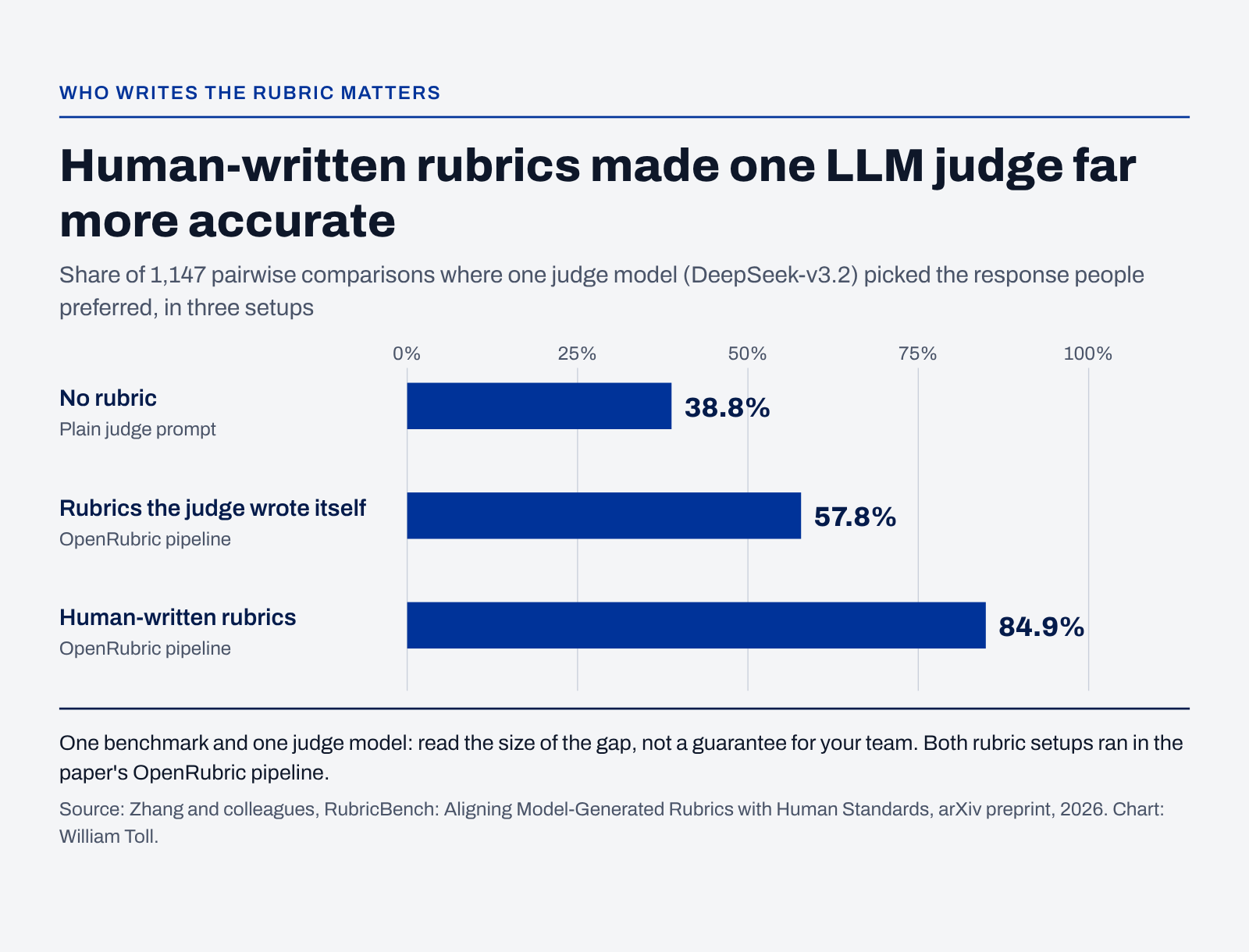
Your criteria carry the expertise. RubricBench, a 2026 preprint, built its test from hard pairs, including pairs where the wrong answer looks better on the surface, such as longer or better formatted. One LLM judge picked the response humans preferred 38.8% of the time with a plain prompt, 57.8% with rubrics it wrote for itself and 84.9% with human-written rubrics. Across the seven judges it tested with both kinds of rubric, human-written rubrics beat self-written ones by 22 to 28 points.
Text version of this figure
Who writes the rubric matters. On RubricBench's 1,147 pairwise comparisons, one judge model (DeepSeek-v3.2) agreed with the human-preferred response: - 38.8% of the time with no rubric - 57.8% with rubrics it generated for itself - 84.9% with human-written rubrics
One benchmark and one model, so read the size of the gap, not a guarantee for your team.
Yes or no for facts. In ResearchRubrics, binary grading raised agreement with human graders by about 20 percentage points over three-level grading. Facts get pass or fail; graded scales stay for editorial judgment.
A relevant source isn't proof. In one citation-verifier study, the best judge of relevance didn't lead on whether a source supported the claim, so every claim needs the passage that proves it.
Writers shouldn't grade themselves. Asking a model to fix its own reasoning without outside feedback can make it worse (Huang and colleagues, ICLR 2024), and models can favor their own text (Panickssery, Bowman and Feng, NeurIPS 2024). Score in a fresh context, apart from the drafting conversation.
Nine parts of a rubric that holds up
Skip one of these and the score stops meaning much. A tagline and a launch plan need the same nine parts.
| Part | What it is | Example |
|---|---|---|
| 1. Decision | One question the score answers | Ready to send to the wire? |
| 2. Dimensions and weights | What matters, weighted by what decides the outcome, totaling 100 | Research integrity and methodology carry 18 of 100 in a research report |
| 3. Observable anchors | What a top, middle and bottom score look like | Population, period, definitions and limitations stated up front |
| 4. Evidence rule | What counts as proof, graded by where it came from | Regulator and platform documents outrank vendor surveys |
| 5. Knockouts and caps | Failures that block release or cap the score | A fabricated statistic fails; a causal claim from a correlation caps a report at 59 |
| 6. Unknown handling | What happens when evidence is missing or can't exist yet | Mark it not yet or not verifiable, leave it out of the total and report coverage |
| 7. Arithmetic in code | Totals, weights and caps computed by script | Assert that weights sum to 100 before any score prints |
| 8. Owner and gate | Who maintains the rubric and who decides | PR lead owns it; CMO approves the thresholds |
| 9. Version and calibration | Version number, change log and agreement with people | Two reviewers score the same set each quarter |
Rubrics can be built for anything: sample rubrics for ten marketing jobs
One anatomy fits every job. Weights, anchors and knockouts change from a tagline to a launch plan; the nine parts stay the same. My press release, research launch and LinkedIn rubrics come from the launch review skill I built, and the check of every asset against messaging comes from the agent architecture I designed. I've run the other jobs with rubrics in my own work, and I wrote the versions here from that practice and public guidance. Treat them as samples: build your own, and add them to your multi-agent workflows.
| Job | Type | Decision | Heaviest dimensions | Knockouts |
|---|---|---|---|---|
| Press releases | Asset | Worth a journalist's time, with numbers that survive quoting | Headline, claim integrity, method disclosure | Fabricated statistic; conflicting numbers across versions |
| Case study pages | Asset | Would a peer believe it and repeat it internally | Outcome evidence, customer approval, problem fit | Invented customer or quote; a result the customer hasn't approved |
| Solution brief PDFs | Asset | Can an evaluator verify every claim without a seller in the room | Proof, first-page clarity, technical accuracy | Roadmap presented as available; uncited comparison |
| LinkedIn posts | Asset | Does each voice do its own job | Expert voices, claim fidelity, native format | Undisclosed employee promotion; engagement pods |
| Taglines | Asset | Does it carry the position in a few words, and can you own it | Fit to positioning, distinctiveness, clarity | A claim you can't substantiate; a mark you haven't cleared |
| Messaging frameworks | Strategy | Can every team prove every pillar | Proof per pillar, positioning clarity, differentiation | A pillar with no proof; aspiration stated as fact |
| Campaign sales enablement | Strategy | Can a rep run the play on day one | Talk track tied to the campaign claim, objection proof, timing | A claim not in the claims ledger; pricing or roadmap promises |
| Research report launches | Workflow | Ready two weeks out, and did it work 30 days in | Method disclosure, earned media, research hub | No method; numbers that conflict across assets |
| Analyst report submissions | Workflow | Accurate, consistent and evidenced at every stage | Evidence, consistency, criteria coverage | Roadmap presented as available; numbers finance can't match |
| Speaking submissions | Workflow | Will a program committee pick this one | Takeaways, first-hand specifics, originality | A product pitch; anything the call's rules forbid |
Rubrics for assets
Press releases
In Cision's 2026 State of the Media, a survey of 1,899 journalists, influencers and other media professionals, data and research (47%), embargoed or early access (45%) and expert access (42%) topped the list of what they want more of from PR.
My press release rubric scores the release in Layer A (50 points) before it goes out, and the media program and outcomes in Layer B (50 points) after launch. Layer A, levels 0 to 4:
| Dimension | Weight | What earns a 4 |
|---|---|---|
| Headline news value | 8 | One number, a precise population and a consequence; 100 characters or fewer |
| Subhead and lead | 6 | A second number plus a method cue; a lead of about 70 words |
| Claim integrity | 8 | Every number has its population, period and source, the same in every version |
| Method disclosure | 7 | Firm, sponsor, dates, mode, population, sample by segment and weighting |
| Machine-readable structure | 6 | Five to eight findings under descriptive headings, plus a sector table |
| Chart pack | 6 | Three to six charts with captions, alt text and source lines |
| Quote and access | 4 | One interpretive quote tied to a number, plus an interview offer |
| Links and contact | 5 | One descriptive link to an ungated hub and a generic press inbox |
Fabricated statistics fail the release. Numbers that conflict across global and regional versions hold claim integrity at level 2.
Case study pages
In The Hidden B2B Journey, a SurveyMonkey and Reddit survey of 1,202 US business decision-makers, 73% trust peer insights above vendor websites (55%), and the survey lists finding real user testimonials (48%) among the key obstacles in early research. Demand Gen Report's 2025 benchmark survey of marketing leaders, which doesn't publish its sample size, found that 57% chose case studies as their top content format.
In the US, the FTC's 2024 rule on reviews and testimonials bars testimonials from someone who doesn't exist, such as AI-generated ones, from someone without actual experience of the product, or that misrepresent that experience. Its text speaks of consumer reviews and testimonials and doesn't mention B2B, so treat that bar as a knockout in B2B anyway.
My rubric weights outcome evidence at 20 (a baseline, a time frame and the measurement method), customer verification and approval at 15, problem and context fit at 15 and the path to the result at 15, with quote specificity and findability in search and LLM answers at 10 each, and freshness, next step and accessibility at 5 each. Findability means a descriptive title and the results summary in HTML text, not inside an image. An invented or composite customer, a quote the customer didn't approve word for word, or a result the customer hasn't signed off fails the page.
Solution brief PDFs
Solution briefs often get forwarded inside the buying group. Machines read them too: Google lists PDF among the file types it indexes (Google Search Central), and W3C's PDF techniques for WCAG 2.2 cover what a PDF needs for screen readers and other assistive technology: alt text, reading order, heading tags, a document title and a default language.
My rubric weights proof (customer results, third-party tests or analyst validation) at 20, problem-to-outcome clarity on the first page at 20 and technical accuracy, signed off by an SE or product manager, at 15. Differentiation, integration specifics, consistency with the website and messaging, and accessibility and machine readability take 10 each, and version and date 5. Roadmap presented as available and an uncited competitor comparison are knockouts. An image-only PDF, with no real text, scores 0 on machine readability, so publish the same content as an HTML page and make the PDF the download.
Company page and employee LinkedIn posts
Company pages and employees do different jobs, so score them with different rubrics. Metricool's 2026 LinkedIn study of 673,658 posts from 63,108 accounts found personal profiles earned a 63% higher engagement rate on average, while company pages got shared more. In my launch reviews, the page is the source of record: findings, method and chart pack. People interpret: what a finding changes for a named buyer.
My social rubric weights executive and expert voices at 14, above company page execution at 10, with claim fidelity and conversation quality at 10 each. Two standards come from outside. LinkedIn says engagement pods and automated comments aren't allowed, and the FTC says employees who post about their employer's products should disclose the relationship, noting that listing the employer on a profile isn't enough. Undisclosed employee promotion caps that dimension, a stat that conflicts with the report caps claim fidelity, and visible pod or automation signals cap the whole score at 50.
When a model drafts a post for an employee, the view has to be one that person holds, in their words, approved by them. Ten employees posting one caption isn't advocacy.
Rubrics for strategy and enablement
Messaging frameworks and taglines
Messaging needs two rubrics. My rubric for the messaging framework weights proof per pillar at 20, positioning clarity and true differentiation at 15 each, and audience overlays, feature-to-outcome chains, objections, governance and machine readability at 10 each. A pillar with no proof is a knockout.
A second rubric, the message evaluation from the agent architecture I designed, scores every asset against the messaging on ten dimensions. Five failures block release whatever the average: fabricated proof, an expired or unapproved claim, confidential disclosure, roadmap presented as generally available, and an uncited comparison. Track coverage too: high volume with low proof coverage means inconsistency at scale.
Taglines get a short rubric: fit to the positioning, distinctiveness against competitors' lines, clarity for a first-time buyer, and range across channels. A superlative you can't substantiate, or a mark your counsel hasn't cleared, is a knockout. Let the model generate fifty; let the rubric and a person cut them to three.
Campaign sales enablement
A campaign fails quietly when reps get the kit late or can't defend the claim. My rubric scores the talk track's tie to the campaign claim, objection responses with proof, persona and stage fit, the email and call sequences against the claims ledger, and timing: the kit lands before the campaign does. A claim that isn't in the ledger, a pricing promise or a roadmap commitment fails the kit. In my launch reviews, sales and customer success enablement and timing is its own scored dimension.
Rubrics for workflows and processes
A workflow rubric scores the plan, not just the output: at a gate before launch with outcomes marked not yet, then again after launch against what happened. Report coverage, the share of weight you could score, with every number.
Research report launches
My launch visibility rubric weights research integrity and method disclosure at 14 and earned media quality at 14, the landing page and research hub at 12, and claim packaging and consistency at 10. Technical discoverability, PDF and visual quality, the press release, owned derivatives and answer-engine visibility take 8 each, with social amplification and measurement at 5 each.
Score it at T-14, two weeks before launch. Earned media and answer-engine visibility can't exist yet, so they're marked not yet and left out of the total, and coverage shows how much of the plan you could judge. Ask practical questions at the gate: is the method on the hub, do the numbers match in every asset, is the chart pack ready, are spokespeople and expert voices lined up, and are UTMs set? Then rescore at T+30 against outcomes.
A report also gets its own asset rubric: research integrity and methodology carry 18 of 100, dataset adequacy 14 and insight originality 12, and a causal claim from correlation caps the report at 59. When I scored two security vendors' research launches, method and dataset disclosure accounted for more than a third of the points each report lost, and twelve fixes would have lifted them from 56 and 61 to about 80 and 83. Both reviews are in my guide to survey and research report assets.
Analyst report submissions
An analyst report submission isn't one document. Gartner, for one, includes every vendor that meets a Magic Quadrant's inclusion criteria, whether or not it participates, and offers every vendor a factual review before publication (Gartner Ombuds). In August 2025 it also said it's exploring AI to surface information vendors gave about one market for reuse in other markets, to cut vendor effort (Gartner Ombuds). My read: consistency with everything you've told analysts matters more than ever.
My rubric scores the submission three times: before the briefing, before the written submission goes in, and on the factual-review response. Evidence for every claim weighs 20, consistency with finance, the website and earlier briefings 15 and coverage of the firm's published criteria 15, with roadmap discipline, differentiation, customer outcomes, clarity and executive sign-off at 10 each. Roadmap presented as available and numbers finance can't match are knockouts.
One more knockout is a policy. Gartner's baseline usage policy, updated in October 2026, bars using its content as input into generative AI, except a licensed user's own labeled summary made in a closed single-user tool that doesn't train a larger model, and terms can vary with the product you license. Build AI prep from your own notes and claims ledger, never from licensed research pasted into shared tools.
Speaking submissions
Committees read a lot: RSAC says more than 2,900 proposals went to 80+ Program Committee members last year. My rubric weights takeaways and first-hand specifics at 20 each and originality at 15, with audience fit, speaker authority, title clarity and timeliness at 10 each and vendor neutrality at 5. A product pitch is a knockout. Check the call's rules, including any on AI-assisted writing, the day you submit.
Score discoverability in every public rubric: SEO, AEO and GEO
Anything the public will find needs a discoverability dimension, and most of my rubrics carry one. Every post on this blog passes two gates: a 25-criterion published-post rubric, where seven criteria (28 of 100 points) cover question fit, metadata, links, answer readiness, source readiness for LLM answers, structured data and technical performance, and a separate 20-point SEO, AEO and GEO check that blocks publishing below 16.
| Rubric | SEO, AEO and GEO dimensions | Weight |
|---|---|---|
| Blog post | Seven discoverability criteria, plus the 20-point gate | 28 of 100 |
| Research report | SEO, AEO and GEO readiness | 10 of 100 |
| Research landing page | SEO foundations; AEO and GEO readiness | 17 of 100 |
| Research launch | Technical discoverability; answer-engine visibility | 16 of 100 |
| Press release | Machine-readable structure; presence in LLM answers | 9 of 100 |
| Executive byline | None in the quality score; LLM citations tracked after publication | Separate scorecard |
My 20-point check scores ten things from 0 to 2: crawl and index eligibility with the right canonical; one intent and reader decision; a title, H1 and snippet that agree; a direct answer that stands on its own; semantic structure; unique information gain; claims traced to primary sources; clear entity and authorship; contextual inbound and outbound links; and schema, dates, metadata and sitemap that match the visible page.
Score what you control before launch and measure what you can't after. Google says its core Search ranking systems underpin its AI features, that SEO best practices still apply, that there's no special schema.org markup to add, and that Search doesn't use llms.txt files (Google Search Central). Since May 7, 2026, FAQ rich results no longer appear in Google Search (Google Search Central), so an FAQ earns its place by answering readers. Rerun the gate after final edits, then require a final human review so the editor can confirm every change fits their style and audience. Citations in LLM answers belong in the after-launch score, tracked on a fixed panel of buyer prompts, the way I track my own posts.
Internal work, such as an enablement kit or an analyst submission, doesn't need a discoverability dimension.
Where rubrics sit in your AI system
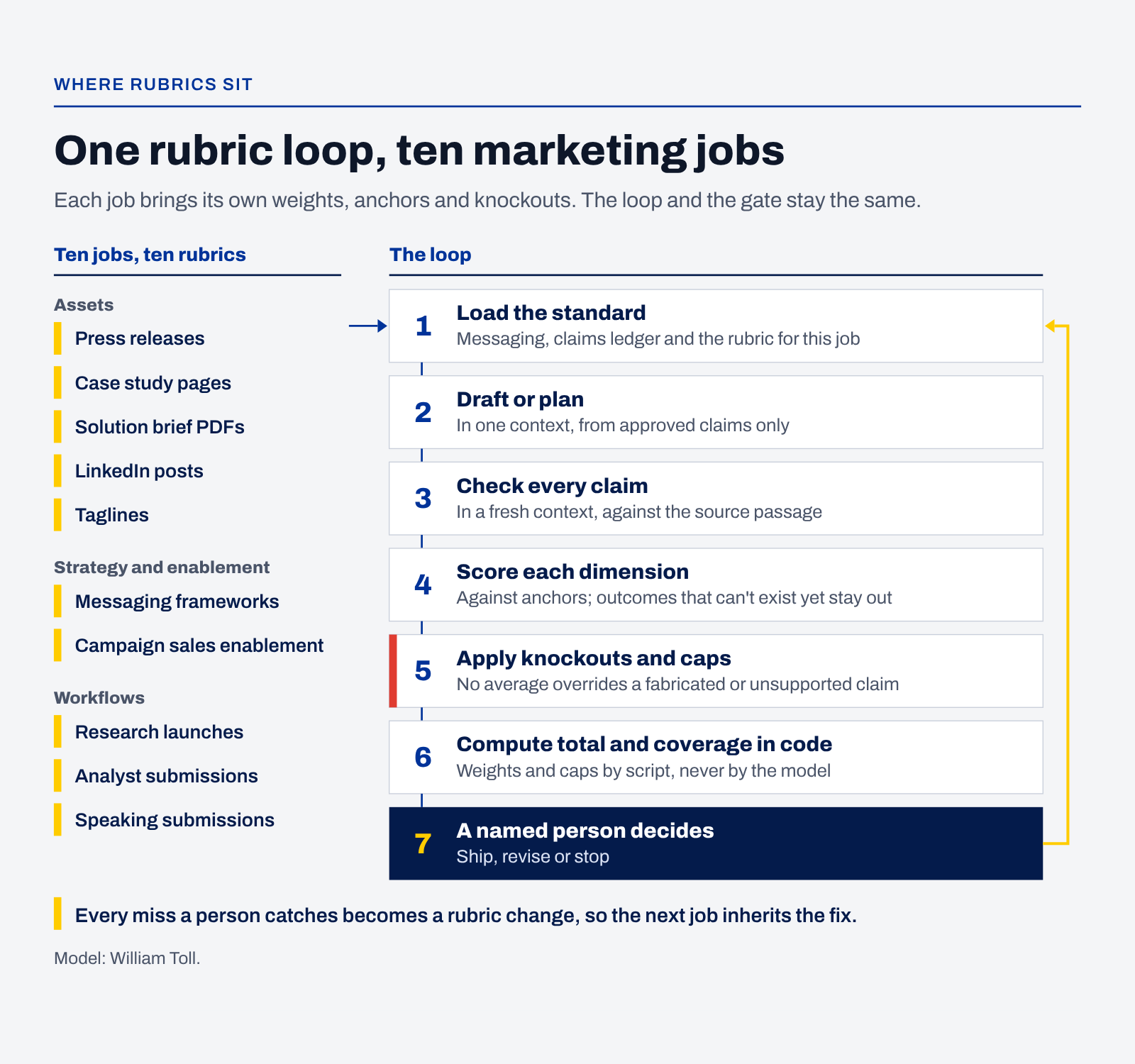
One loop runs through every asset and every workflow gate, and every miss becomes a rubric change. Add your rubrics to your multi-agent workflow so checks rerun at every draft, review and edit.
Text version of this figure
Ten jobs feed one loop. Assets: press releases, case study pages, solution brief PDFs, LinkedIn posts and taglines. Strategy and enablement: messaging frameworks and campaign sales enablement. Workflows: research report launches, analyst report submissions and speaking submissions. 1. Load the standard: messaging, claims ledger and rubric. 2. Draft or plan in one context. 3. Check every claim in a fresh context. 4. Score each dimension; outcomes that can't exist yet stay out. 5. Apply knockouts and caps. 6. Compute the total and coverage in code. 7. A named person decides: ship, revise or stop.
Every miss becomes a rubric change.
Three rules keep the gates honest. Missing isn't a pass: an empty required score gets no verdict. Gates must bite: a gate that never blocks for a month is broken or bypassed. Limit revision: after two rounds of fixes, a person decides whether to revise, restart or stop.
Give every rubric an owner and every gate a named decider; the playbook maps who owns what, role by role.
How to know your rubric works
A rubric that agrees with itself isn't proof it's right, so test the reviewer.
- Build a labeled set. Take 30 to 50 past examples, including known failures, labeled by two people.
- Count false passes and false rejects separately. A missed fabrication costs far more than a few flagged good drafts.
- Report denominators. Zero misses in 20 known failures still leaves a one-sided 95% upper bound of about 14% on the miss rate.
- Control for length in side-by-side tests. In JudgmentBench, the better legal output was longer in 99.3% of pairs. When researchers made the weaker output longer, human annotators picked the better one 43.7% of the time, down from 70.3%.
- Version the rubric. Criteria drift as reviewers grade more outputs (Shankar and colleagues, UIST 2024), so compare scores only within a version.
What rubrics caught in my own work, and what they missed
Thirteen days after launch, my analyst relations post earned citations in 9 of 42 answers across Google AI Mode, Perplexity and ChatGPT on the 14 questions I track. That post also shows what rubrics miss. My rubric scored it 94, yet it told readers they couldn't use Gartner research with Claude or ChatGPT; Gartner's policy has one narrow exception. My LLM citation test caught the gap, and I published a correction. A rubric's accuracy check is only as deep as the reading behind it.
Where to start
CMOs: pick the asset or workflow where one wrong claim costs the most, often a press release, a case study or a research launch, and name an owner for its rubric and gate. Approve the thresholds and one business measure beside the score.
Product marketing leaders: encode your positioning, proof and voice once, in a source every AI tool loads, then write the messaging framework rubric, because every other rubric checks against it. That's question 4 in my five-question AI maturity score.
Then take five steps:
- Choose one asset or workflow, start from a sample rubric here and make it your own.
- Write the knockouts and the evidence rule before the weights.
- Score 20 to 30 past examples with two people, then with the model, and compare.
- Add it to your multi-agent workflow, with a person deciding at the gate.
- Track block rates, false passes and the business measure, and version the rubric when you learn something.
If you want the full set, request the playbook: 15 sample rubrics, guides for 11 marketing roles, a rubric file template, a reviewer prompt, a 90-day rollout plan and four worksheets.
Where this can fall short
FAQ
What is an AI marketing rubric?
An AI marketing rubric is a scoring standard for one kind of marketing asset or one workflow stage, with weighted dimensions, observable anchors, an evidence rule and knockouts that block release regardless of the average. Some teams call it a content scoring rubric. A separate reviewer, a model or a person, applies it in a fresh context. Code computes the total, and a named person decides what ships.
Can an LLM grade its own marketing content?
Not reliably on its own. Self-correction without outside feedback can make reasoning worse, and models can favor their own text. Score drafts in a fresh context with the source passages, and calibrate the judge against two human reviewers. In RubricBench, one judge matched human preferences 84.9% of the time with human-written rubrics and 57.8% with its own.
Can a rubric score a workflow, not just content?
Yes. A workflow rubric scores a plan or process at a gate. For a research report launch, score the plan two weeks out, mark outcomes such as earned media as not yet scored, and report how much of the weight you could judge. Rescore the same rubric 30 days after launch against results.
When should rubric checks run in an AI content workflow?
At every stage, not once at the end. Add your rubrics to your multi-agent workflow so the checks run on the brief, the draft, the review and each round of edits. Rerun the SEO, AEO and GEO rubric after final edits, then require a final human review so the editor can confirm every optimization fits their style and audience.
What should a case study rubric score?
A case study rubric should score outcome evidence with a baseline, time frame and measurement method; customer approval; fit to a buyer's problem; the path to the result; specific quotes; and a results summary in HTML text. An invented customer, an unapproved quote or an AI-generated testimonial presented as real should fail the page; the FTC's 2024 rule bars the invented and AI-generated kinds.
Sources
- Lee and colleagues, CheckEval: A reliable LLM-as-a-Judge framework for evaluating text generation using checklists, EMNLP 2025
- Zhang and colleagues, RubricBench: Aligning Model-Generated Rubrics with Human Standards, arXiv preprint, 2026
- Sharma and colleagues, ResearchRubrics: A Benchmark of Prompts and Rubrics For Evaluating Deep Research Agents, arXiv preprint, 2025
- Leung and colleagues, Do You Need a Frontier Model as a Citation Verifier? Benchmarking Rubric LLMs for Deep-Research Source Attribution, arXiv preprint, 2026
- Yang and colleagues, JudgmentBench: Comparing Rubric and Preference Evaluation for Quality Assessment, arXiv preprint, 2026
- Huang and colleagues, Large Language Models Cannot Self-Correct Reasoning Yet, ICLR 2024
- Panickssery, Bowman and Feng, LLM Evaluators Recognize and Favor Their Own Generations, NeurIPS 2024
- Shankar and colleagues, Who Validates the Validators? Aligning LLM-Assisted Evaluation of LLM Outputs with Human Preferences, UIST 2024
- Move Forward Strategies, 2026 State of AI and B2B Marketing Report, 2026 (277 B2B marketing leaders in the UK and Ireland; no field dates published; Move Forward Strategies is a B2B marketing agency)
- Cision, 2026 State of the Media Report, 2026 (1,899 journalists, influencers and other media professionals in 19 markets, fielded January and February 2026; Cision sells PR software)
- SurveyMonkey, New research from SurveyMonkey and Reddit reveals why trust is the new currency in B2B buying, March 10, 2026 (The Hidden B2B Journey: 1,202 US business decision-makers, fielded December 23, 2025 to January 7, 2026; SurveyMonkey sells survey software and Reddit sells advertising)
- Demand Gen Report, 2025 Demand Generation Benchmark Survey Results Are In, July 8, 2025 (sample size and method not published)
- Federal Trade Commission, Federal Trade Commission Announces Final Rule Banning Fake Reviews and Testimonials, August 14, 2024
- Federal Trade Commission, FTC's Endorsement Guides: What People Are Asking
- Google Search Central, File types indexable by Google, updated February 3, 2026
- W3C, Techniques for WCAG 2.2: PDF Techniques, updated May 11, 2026
- Metricool, Metricool's 2026 LinkedIn Study Reveals the Rise of Invisible Interactions as Video Performance Slips, April 14, 2026 (673,658 posts from 63,108 accounts; engagement rate not defined; Metricool sells social media software)
- LinkedIn Corporate Communications Team, What We're Doing to Support Authentic Content and Conversations on LinkedIn, March 13, 2026
- RSAC, RSA Conference 2027 Call for Submissions, viewed November 20, 2026
- Gartner Office of the Ombuds, Why Vendors Cannot Withdraw From Gartner Magic Quadrants, February 27, 2025
- Gartner Office of the Ombuds, Understanding Gartner Market Coverage, August 29, 2025
- Gartner, Gartner Usage Policy (Internal Use section), updated October 2026
- Google Search Central, Google's Guide to Optimizing for Generative AI Features on Google Search, updated July 10, 2026
- Google Search Central, Latest Google Search Documentation Updates (FAQ rich result deprecation, May 8, 2026)
Topics: ai-native-marketing, governed-agents, product-marketing, messaging, llm-answers. How I research and write these posts: editorial standards.